How To Ask for Client Testimonials (& Get Specifics)
Client testimonials are one of the simplest ways to earn trust before someone decides to schedule an appointment or class with you. Oftentimes, new clients want proof that people like them had a good experience — not just your own claims.
The tricky part is that while most service business owners know testimonials matter, they’re not sure how to get client testimonials without it feeling awkward, pushy, or time-consuming.
That’s why we’ve put together this article that includes a simple step-by-step and some practical tips. We’ll also cover what counts as a testimonial, how it’s different from a review, and when to ask so you get great responses more consistently.
What Counts as a Client Testimonial?
A testimonial is a story-based quote or personal anecdote from a client talking about their positive experience with your shop. You would typically feature these in your marketing, like on your website, social media, or in an email newsletter.
Some use “testimonial” interchangeably with “review,” but they’re not quite the same. A review is usually shorter and always posted on a third-party platform (like Google or Yelp) where anyone can see it, and you don’t control how it shows up.
Both testimonials and reviews help build trust and are equally important in improving your chances of getting more clients.
The good news is that you can ask for both pretty much the same way — by nudging the client to share their experience and what stood out. And that’s exactly what we’ll be discussing in the next few sections.
What Makes a “Good” Testimonial?
A good testimonial isn’t necessarily long; it just has to be specific enough, especially given how many testimonials end up being one-liners that are too vague. Below are some client testimonial examples to give you a better idea:
| Category | ❌ Vague testimonial | ✅ Specific testimonial (better) |
|---|---|---|
| Hair salon | “Amazing service, highly recommend!” | “I was nervous about how my hair would take color, but they talked me through options, and it turned out exactly how I wanted. I’ve already booked my next appointment!” |
| Tattoo studio | “Super talented. Love my tattoo!” | “I came in with a rough idea and they helped me tighten up the design so it fit my arm perfectly. The linework is clean, the shading healed evenly, and they made the whole appointment feel calm and professional.” |
| Barbershop | “Best barber in town. Great cut!” | “I’m picky about fades because you can see every little line, and yet they blended it perfectly. No harsh edges, no patchy spots — it looks smooth from every angle.” |
| Fitness studio or trainer | “Fun class! Loved it!” | “I usually feel lost in group workouts, but the coach explained the moves clearly and gave me a modification that worked for my knee. I felt challenged but not overwhelmed, and I actually want to come back next week.” |
In the case of service businesses, the best testimonials cover three things: the problem (what the client needed or was dealing with), what you/your staff did (what stood out or what they liked about working with you), and the result (what changed after the service).
However, some clients end up giving vague testimonials because they’re either busy, not sure what details you want, or don’t want to spend 10 minutes writing.
So, if you want something more useful and can better convince the next person to book, you have to guide them a bit. Give them a couple of quick questions so they can reply with real details without feeling like they’re doing homework.
When Should You Ask for a Testimonial?
Timing matters a lot because clients or customers tend to give the best testimonials when the experience is still fresh, and they’re already feeling happy with the result. The following are the most ideal moments to ask for a testimonial:
- Right after a client gives you a compliment (either at the end of a session or via text/DM later on)
- Once they’ve had a chance to see the results (e.g., later that day or a few days later)
- After a successful first appointment or class with you
- After a few repeat visits, when you know they’re genuinely and consistently satisfied with your services
It’s usually not a great time to ask when the client is rushing out the door, distracted at checkout, or if you just had to fix something that went wrong. Even if things turned out fine, most people won’t feel motivated to write about it in that moment.
[cta_universal_1 badge=”Built for every type of service business” title=”A scheduling tool that sends follow-up emails for you” subtitle=”Set up emails that clients will automatically receive after their appointment, class, or workshop.” button_text=”Try Bookedin” url=”https://bookedin.com/appointment-booking-payment-system-plans-and-pricing/”]
Also read: How To Handle Difficult Clients & Avoid Negative Reviews
How To Get Testimonials From Customers or Clients
Asking for testimonials (or even reviews) doesn’t have to be awkward or time-consuming. Here’s a step-by-step guide for how to get client testimonials, no matter what type of service business you run.
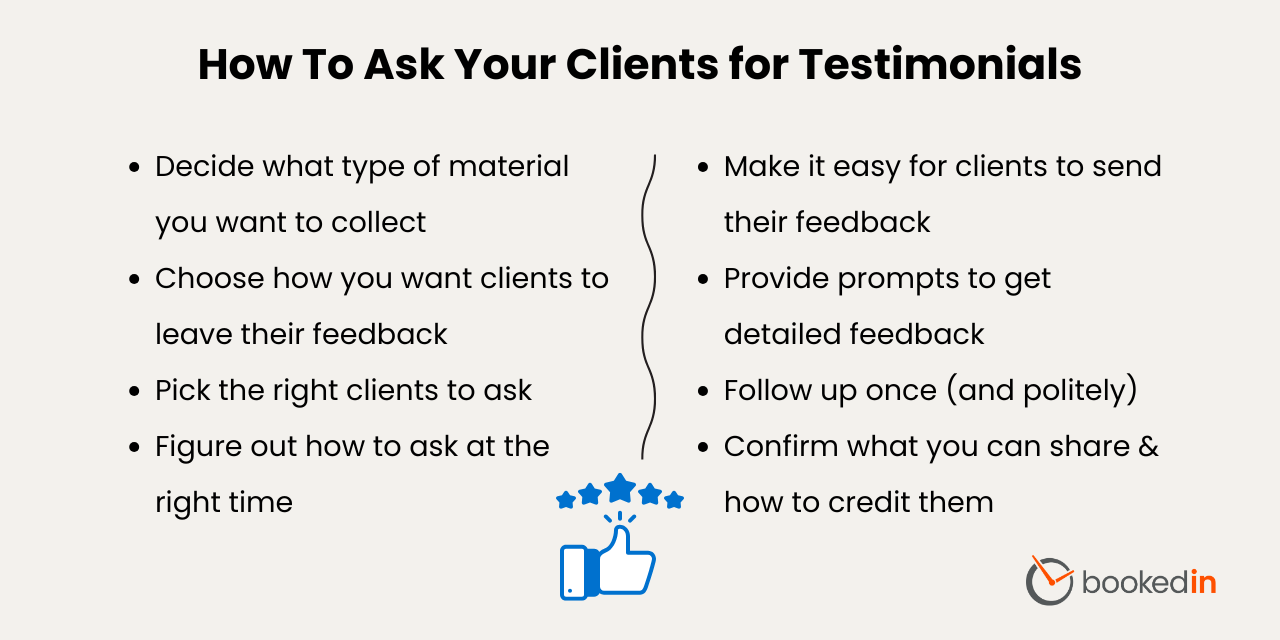
Step 1: Decide what type of material you want to collect
Before you ask clients for anything, you should first settle on what you’re trying to achieve. If your goal is to make your website, social media, or booking page look more credible, a testimonial is usually the best fit because it can be longer and more story-based.
On the other hand, if your goal is to help new people easily find you online, reviews matter more because they’re often how people discover local businesses through popular platforms like Google.
Sure, a lot of service businesses benefit from collecting both, but you don’t have to do that right away. It’s best to pick one priority first, then work on the other once the process feels easy.
Step 2: Choose how you want clients to leave their responses
If it’s a testimonial, you can have them reply to an email, fill out a short form, or send you a quick DM. You can even let them pick whichever feels most convenient, given their schedule.
Meanwhile, if it’s a review, you’ll usually want to send a link leading to the platform you care about most, which is often Google. That way, they don’t have to waste time looking for where exactly to post it.
In short: The simpler the path, the better the response rate.
Step 3: Pick the right clients to ask
By “right clients,” we mean those who are most likely to say yes and give you something useful.
Regulars are your best bet because they already trust you and can vouch for your service consistency. Given how they’ve been coming back, their feedback can reassure potential clients (especially those nearby) that you’re indeed a dependable go-to.
However, first-timers who might have been nervous or hesitant at the start can be a smart choice, too. After all, their story would likely match exactly how another potential client might feel.
Referral clients are also a solid pick, since they already came in trusting feedback about your services, and can often explain why they’d recommend you to others as well.
You should also consider clients who saw a major, noticeable result from your service — like a new hairstyle, a custom tattoo, or real progress toward a fitness goal. They’re more likely to give a detailed testimonial, since they can point to a clear before-and-after.
Step 4: Figure out how to ask clients at the right time
Since we’ve already covered the “when you should ask” in the previous section, think of this step as choosing the timing that’s most realistic for you to stick with.
Good timing is less about finding the “perfect moment” and more about asking when the experience is still fresh in the client’s mind, and they’re in a good mood about the result.
If you wait too long, the details get fuzzy, and responses tend to turn into generic one-liners. So, pick a timing that naturally fits into how you already run your appointments or classes, and do it the same way each time (or at least, as often as possible).
This also makes it easier for you and your staff to remember, instead of having to decide in the moment whether to ask for a client testimonial or not.
Step 5: Make it easy for clients to send their feedback
Most clients won’t write a long testimonial, even if they adore you — and that’s normal. Your job is to make the process as easy and straightforward as possible for the client.
For instance, you can tell them that even just 2–3 sentences is great, or that they can answer in several bullet items if that’s easier. If you’re using a link, make sure it leads to a page that’s mobile-friendly since most people will do it on their phones.
[cta_universal_2 badge= title=”Testimonial requests, sent automatically” subtitle=”Customize follow-up client emails once and they go out after every visit — no manual sending needed.” button_text=”Get started” url=”https://bookedin.com/appointment-booking-payment-system-plans-and-pricing/”]
Step 6: Provide simple prompts to get clear, detailed feedback
If you just say, “Can you leave a testimonial/review?” you’ll often get some short, generic praise in return. When clients don’t know what you expect from them, they’ll respond with the shortest, easiest compliment they can think of.
That’s why it’s best to give prompts or questions that give the client an easy starting point and a clear idea of what to include.
Below are some quick questions to ask for testimonials. Make sure to use only one or two at a time, depending on which makes the most sense for that particular client.
- What did you like most about the experience (or the way we handled it)?
- What were you hoping to get help with before you came in?
- What was different after your appointment/class compared to before?
- Was there anything you were nervous about at first? What changed your mind?
- What made you choose us over other options?
- If a friend asked why you recommend us, what would you say?
- What stood out about the service (the result, the process, or how you were treated)?
Step 7: Follow up once (and politely)
Even happy clients sometimes forget or put off sending their testimonial or review, so don’t take it personally. A single, gentle reminder is usually enough to catch them at a better time, especially if your first ask came when they were busy.
Keep your tone casual, assume they meant to do it, and make it easy for them to act by re-sharing the same link or repeating the question. Here’s one way you can go about it:
Hi, [Client’s Name]! Quick reminder that if you still have a minute to leave us a [testimonial/review], here’s the link again: [LINK]. No rush at all, and thank you!
If they still don’t give anything after one follow-up, let it go. You don’t want to come off like you’re pressuring them. It’s not worth making things awkward just to get one more review.
Step 8: Confirm what you can share and how to credit them
This step is important as it protects you and your team, and keeps everything respectful with the client.
Before you post anything publicly, make sure you have clear permission from the client. Ask how they want their name shown (either full name, first name only, or just initials), especially if privacy matters in your industry.
You’ll also need to get explicit permission if you want to use a photo that includes them, and tell them where you plan to share it.
It also helps to mention the likely places you’ll feature their testimonial, like your website and social media pages, so they know exactly what they’re agreeing to.
Also read: 12 Best Ideas for a Client Appreciation Event
Where To Put Client Testimonials You’ve Collected
Testimonials are most useful when a potential client sees these at the moment they’re still deciding whether to book.
In most cases, that happens before they visit your booking page, usually while browsing your website and social media pages. It can also be on your Google Business Profile, where people compare you alongside other local options.
Once you know where people are looking, it’s easier to choose the actual spots to feature testimonials.
In most cases, those would be a pinned Instagram post, a series of Story Highlights, your website homepage, and even part of your email newsletter.
Turn Follow-Ups Into More Testimonials With Bookedin
At the end of the day, testimonials and reviews are proof that real people trust you — and that’s exactly what new clients are looking for before they book.
If you make asking part of your routine, keep it easy for clients to respond, and guide them with a prompt or two, you’re more likely to collect enough feedback that are genuine and meaningful.
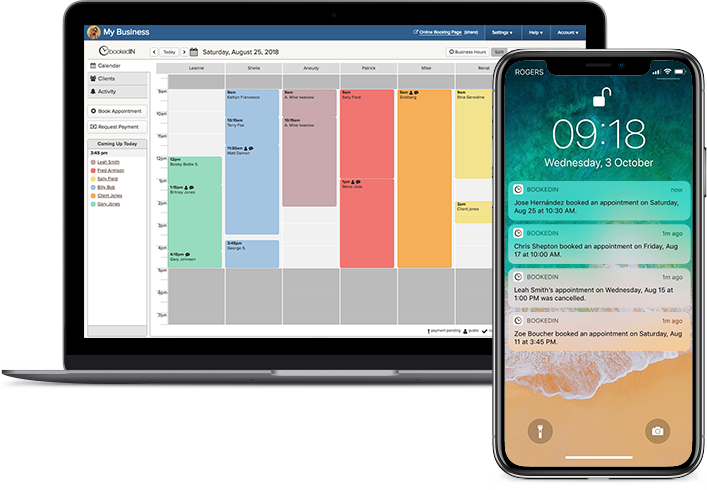
If you want to make this process even easier, a tool like Bookedin can help you stay consistent.
After an appointment or class, you can set up your Bookedin account to send a short follow-up message thanking the client and asking for a quick testimonial or review.
Book a free demo & see how it works
Bookedin also comes with various features that many service businesses rely on, such as automated appointment reminders, payment processing, self-serve online booking, and multi-staff scheduling.
If you’d like to see how it would work for your business, you can sign up for free and start with a 14-day trial.
About the Author

With over a decade of experience across startups, online publications, and agencies, Marcy is all about delivering content that connects brands with the audiences they're trying to reach.