How To Handle No-Show Clients: Message Templates & Policy Tips
A no-show is more than just a gap in your day. There’s the prep time you can’t get back, the others clients you turned away for that spot, and the quiet frustration of it all. It happens to every service business sooner or later, and for all kinds of reasons.
Yet, the impact of no-shows on your schedule and money is always the same: Across all industries, the average no-show rate sits around 10–15%. For a small business earning about $250,000 a year, that can easily add up to $26,000 in lost income.
That’s why knowing what to say to no-show clients is important. In this guide, you’ll learn exactly how to navigate these kinds of situations (complete with message templates you can copy-paste), as well as practical ways to prevent these in the future.
Tips for How To Handle a No-Show Client
Here are some important tips to keep in mind whenever you’re deciding what to say to no-show clients.
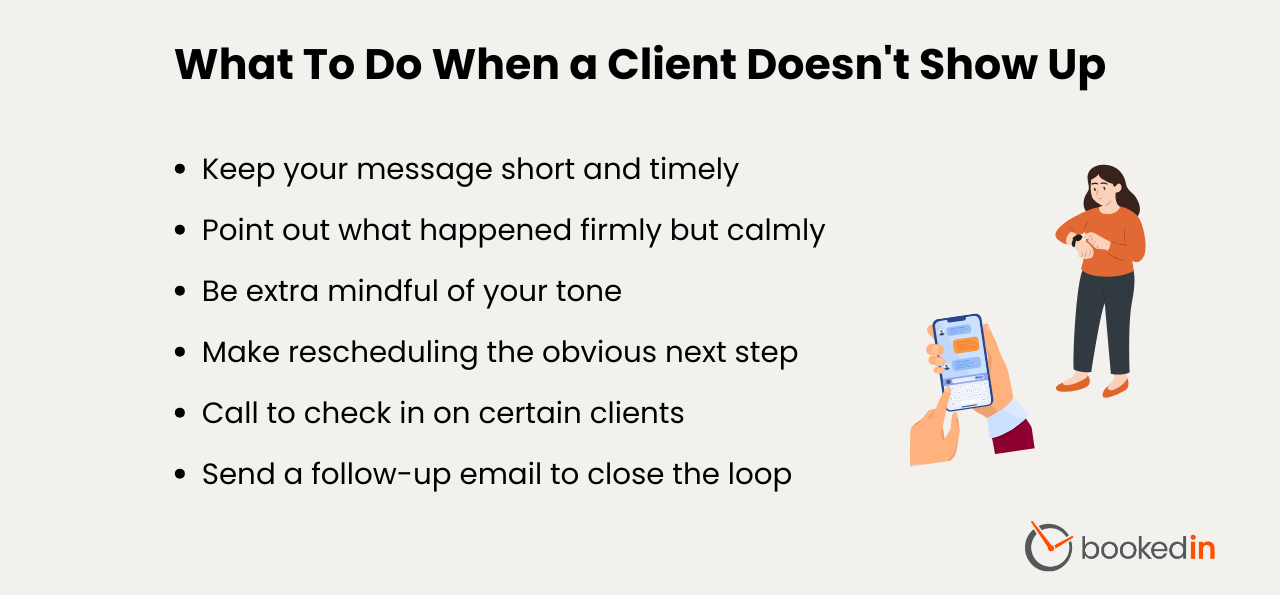
1. Keep your message brief and timely
Your no-show client doesn’t need a long explanation or a guilt trip. In most cases, it comes down to three things: a quick “We missed you,” a reminder of what they missed, and an easy way to rebook.
Short messages are less intimidating to open and reply to, especially if the client already feels awkward for not showing up. On your end, a brief, to-the-point text or email makes you sound calm and prepared, instead of flustered or upset.
A simple rule of thumb: If your message to a no-show client takes more than 20–30 seconds to read, it’s too long. Save the extra details or policy explanations for a follow-up email if you need to.
Also, it’s best to reach out within an hour to 24 hours after the missed appointment. That’s when they still remember the appointment clearly and are more likely to reply.
2. Point out what happened firmly but calmly
When you reach out, be clear about what actually happened. Avoid vague lines like, “I think you had something booked today?” that make you sound unsure and make it easier for the client to pretend they’re not sure what you’re talking about.
Instead, be specific and factual. You can say something along the lines of, “You had an appointment booked today at 3 p.m. for a 1:1 coaching session, and we didn’t hear from you.”
Don’t think of it as scolding your clients, but rather, simply stating the facts so there’s no misunderstanding. This is especially important if you’re about to mention your no-show policy, a fee, or what happens next.
Clarity keeps the conversation clean and professional and makes it more likely that the client will reply honestly without getting defensive.
3. Be extra mindful of your tone
You’re allowed to be annoyed. After all, no-shows can significantly throw off your schedule or negatively affect cash flow.
But if that frustration is obvious in your message, it can push the client away instead of bringing them back. So, skip guilt-tripping, passive-aggressive lines like, “I sat here waiting, and you never showed,” or anything that comes across as blaming or shaming.
At the same time, make sure you avoid apologizing for having policies in place. Saying “Sorry, but I have to charge you…” makes it sound like you’re doing something wrong when you’re not. Your policies exist to protect your business.
Aim for a tone that’s neutral, professional, and kind. Lay out the facts, remind them of your policy, and then tell them exactly how to move forward. Assume good intent unless you have a reason not to. Emergencies happen, people forget, kids and jobs and traffic get in the way.
4. Make rescheduling the obvious next step
If your goal is to get that no-show client back on the calendar, you want to provide them with a convenient way to reschedule. That said, they shouldn’t have to hunt for your website, look up your number, or dig through old messages to figure out what to do.
Instead, tell them in your message exactly what the next step is. That might be including a direct booking link or a simple instruction (e.g., “Text me back with a time that works for you this week”). The clearer and simpler the next step is, the more likely they are to actually take it.
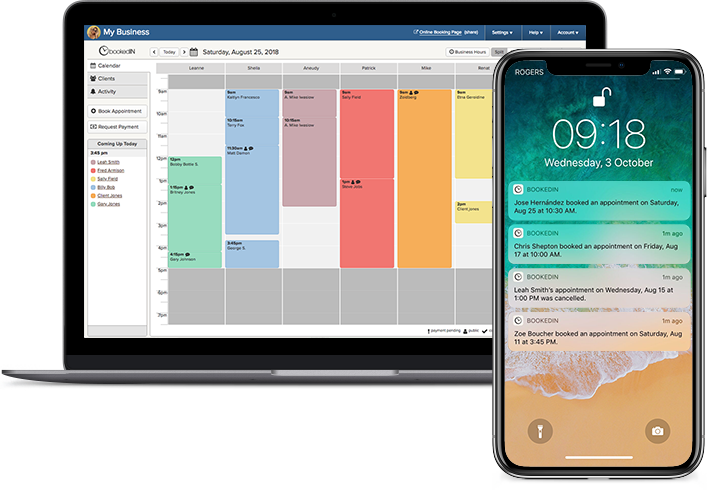
If you’re using scheduling software like Bookedin, this is where it really helps. You can drop your booking page link right into the message so they can see your real-time availability, reserve a new slot, and automatically get updated confirmations and reminders.
See these Bookedin features in action
5. Call to check in on high-value or long-time clients
Not every no-show warrants a phone call; most can be handled with a quick text or email. However, there are situations where picking up the phone is worth the extra effort.
You should strongly consider calling long-time regulars, people who booked a high-ticket service, or clients who have never missed an appointment before.
These are the clients who bring in steady revenue, refer others, or book a big chunk of your time. A short, friendly call can sound like this:
“Hey Jamie, it’s Alex from [Business Name]. We had you down for a 10 a.m. session today and didn’t see you. Just wanted to check in and make sure you’re okay, and see if you’d like to reschedule.”
This isn’t about grilling them or demanding an explanation. It’s a chance to show you don’t take them for granted and that you’re willing to put in a little extra effort to keep the relationship strong, not just to secure your sales.
6. Send a follow-up email to close the loop
Texts and calls are great for quick contacting, but email is where you can neatly tie everything together. Think of it as your “official” follow-up after a no-show.
In your email, you can reiterate what the client missed, remind them of your no-show or late-cancellation policy, and explain any fee or deposit you’re keeping (if any).
This email also gives you room to share your booking link again and answer common questions in one place. That way, you’re not repeating yourself in multiple messages.
Putting everything in writing protects both you and the client. If they’re confused later or forget what you agreed on, you can point back to that email. It backs up your quick, friendly text with a clear written record and keeps your process consistent every time someone doesn’t show.
Also read: 8 Effective Ways To Keep Your Clients Coming Back
Best Message Templates To Send to No-Show Clients
Use the templates below as starting points that you can customize to fit your tone and policies. Swap in your own info anywhere you see brackets.
For appointments with a deposit or card on file
Email version:
Subject: We missed you today, [First Name]!
Hi [First Name],
We had you booked for [name of service/class/workshop] today at [time], but it looks like we didn’t get a chance to see you. I just wanted to check in and make sure everything’s okay.
Because this time was reserved especially for you and we weren’t able to fill the spot, our [no-show/late cancellation] policy applies, and a fee of [amount or percentage] will be charged to the [deposit/card on file].
If you’d like to book a new time, you can do that here: [booking link]. If you have any questions about the policy, just hit reply—I’m happy to clarify.
Best,
[Your Name]
[Business Name]
Text version:
Hi [First Name], we missed you for your [name of service/class/workshop] at [time] today. Our no-show policy applies, so a fee of [amount] will be charged to your [deposit/card]. You can grab a new time here: [booking link].
Reply with any questions.
For appointments without a deposit
Email version:
Subject: Missed your appointment—want to reschedule?
Hey [First Name],
It looks like we missed you for your [service/meeting] at [time] today. No worries, we get it — things happen.
If you’d like to reschedule, you can grab a time that works for you here: [booking link].
If the appointment’s no longer needed, a quick reply to let us know is always appreciated.
Thanks,
[Your Name]
[Business Name]
Text version:
Hi [First Name], we missed you for your [service] at [time]. You can grab a new time here: [booking link]. If you no longer need the appointment, just reply “cancel.”
What If a Client No-Shows Twice?
A one-time no-show is usually an honest mistake. A second one is a pattern, and you should handle that a little differently.
For a repeat offender, it’s only fair to tighten the rules. Many businesses move chronic no-shows to a “deposit required” or “prepay to book” status. That way, the client can still come back, but you’re no longer the one absorbing the risk.
When you do need to have that conversation, keep it short and factual. Below is an example of what you can say (whether on text, email, call, or in person):
Hi [Client’s Name], I noticed we’ve missed a couple of your booked times now. I’d love to keep working with you, but just so we’re both covered moving forward, I’ll ask for a deposit to hold your spot.
It goes toward your service total, and and it’s fully refundable as long as you cancel at least [X hours] ahead.
Online scheduling built to prevent no-shows
Collect deposits upfront and automate client reminders, so you don't have to chase anyone.
Ways To Prevent Clients From Missing an Appointment
Beyond knowing what to say when a client doesn’t show up, it’s also important to know how to prevent no-shows from happening in the first place.
Here are simple changes that make a big difference in terms of protecting your schedule (and sanity).
1. Build stronger relationships with your clients
More often than not, clients are less likely to ghost an appointment with you if they feel they have a solid working relationship with you. It’s easy to ditch “another appointment” without second thought, but often harder to skip their tattoo artist, trainer, or stylist.
You don’t need a complicated loyalty program to do this. Start with small habits like using their name often, remembering one or two personal details, and showing you remember what happened during their last session.
Those tiny touches tell clients, “You’re not just a time slot to me.” Over time, that makes clients think twice before skipping without notice. They might still need to cancel, but they’re more likely to tell you instead of just disappearing.
2. Put your late-cancellation and no-show policy in writing
A clear policy gives you something solid to point to when a no-show or late cancellation happens. If you don’t have one yet, start with the basics:
- How far in advance clients must cancel or reschedule (for example, 24 or 48 hours)
- What you consider a “no-show” (no contact by a certain time)
- What happens if a client doesn’t show up or cancels way too late (e.g., fee, deposit loss, and/or limits on future bookings)
Once you’ve written these down, put them up where clients actually see: on your booking page, in confirmation emails and texts, and in reminder messages. If you have a website FAQ or a link in your social bio, add it there too.
The goal is to set expectations from the get-go. When clients know the rules ahead of time, enforcing your policy later doesn’t feel like a surprise punishment.
Note: If you’re not sure where to start, you can check our no-show policy template in the next section.
3. Use deposits strategically
You don’t have to charge a deposit for every single visit. But these can be a lifesaver in certain situations: long or high-value appointments, limited time slots, or clients who’ve already no-showed you more than once.
Even a small deposit changes how people treat the appointment. When there’s money attached, their mindset goes from “I’ll try to make it” to “I need to be there, or at least let them know if I can’t.”
Deposits also help filter out the “maybe” clients and make space for people who are serious about showing up.
With a scheduler like Bookedin, you can collect deposits or full payments right when clients book online. You can also keep cards on file so you’re not chasing people down after the fact.
4. Use a tool that automatically handles client reminders
Most no-shows aren’t personal. In fact, data shows that around 35.5% of missed appointments or sessions happen simply because clients forgot, while 31.5% are caused by poor communication (like unclear info or not enough reminders).
That’s why automated reminders are one of the easiest ways to help prevent missed appointments without adding more work to your plate. This is especially easy if you use Bookedin!
Clients get a confirmation as soon as they book, then reminder emails or texts before their appointment (say, 48 hours and 24 hours ahead). Those messages can include a direct link to reschedule or cancel, so they can change their plans without ghosting you.
You can also add a short line about your policy in each message, like “Need to cancel? Please do so at least 24 hours in advance to avoid fees.”

Your no-show policy, on autopilot
Add deposits to your booking flow, set up automatic reminders, and keep your schedule intact — without the extra work.
5. Offer online appointment options (if you can)
Granted, this won’t fit every business; after all, some services have to be done in person. But if your work can be done online or partly online, offering flexible options can seriously cut down on no-shows.
For example, if you’re a coach or consultant, consider offering sessions via video call. If you’re a tattoo artist or a photographer, it might be best to offer short virtual consultations before the in-person session.
When clients know they can join from home, the office, or even their car (for certain types of calls), it removes a lot of barriers: traffic, childcare, commute time, bad weather. Fewer barriers usually mean fewer no-shows.
No-Show Policy Template You Can Copy & Paste
Not sure how to word your own policy? Below is a simple no-show policy template you can copy, tweak, and paste onto your booking page, confirmation messages, and reminders. Just swap in the details that fit your business.
[Business Name] Cancellation & No-Show Policy
Need to change your appointment? Just give us at least [minimum number] hours’ notice. If you don’t arrive within [number of minutes] of your start time and we haven’t heard from you, it’s marked as a no-show.
Late cancellations are charged [amount or %] of the service price, and missed appointments without notice are charged [amount or %] to your [deposit/card on file]. [Longer/high-value] services require a [amount or %] deposit at booking, which goes toward your total.
If an emergency comes up, just reach out as soon as you can and we’ll do our best to work something out.
Prefer a ready-made version? You can also download the template file below that you can customize and print.
No-show & cancellation policy template
Avoid Missed Appointments & Late Cancellations With Bookedin
Yes, no-shows are part of running a service-based business, but they don’t have to quietly drain your time and income.
When you know what to say and how to handle a no-show client, you protect both your relationship with clients and your boundaries as a business.
The good news is you don’t have to do everything manually. Across service industries, tools like online booking and automated reminders have been shown to cut no-shows by roughly 25–50% — sometimes even more in certain fields.
With Bookedin, you can set up these features (and a whole lot more!), and let its systems do the heavy lifting for you. Haven’t gotten the chance to try all of Bookedin’s features? Start your free 14-day trial today and see how much smoother your schedule can run.
Frequently Asked Questions
When's the best time to send a follow-up message after a no-show?
It’s usually best to follow up within one hour to 24 hours after the missed appointment.
That way, the booking is still fresh in your client’s mind, and they’re more likely to respond. If you reach out too late, it can feel awkward or easier for them to ignore.
Is it legal to charge clients a fee for no-shows?
Yes. In many places, it’s allowed to charge a no-show or late-cancellation fee as long as you clearly explained the policy before the client booked.
That means your fee structure should be written on your booking page, confirmations, and reminders, not hidden in fine print. However, rules can vary depending on your country or state, so it’s smart to double-check with a local accountant, lawyer, or industry association.
How can I follow up with a client who missed an appointment without offending them?
Keep your message short, calm, and factual. Let them know you missed them, clearly state which appointment they didn’t attend, and offer a simple next step (like a booking link) instead of lecturing them.
Avoid guilt-tripping language or anything that sounds like you’re angry at them personally. If you need to mention a fee, tie it back to your written policy so it feels fair and professional, not emotional.
What do you say to a client who no-shows for the second time?
Be direct but professional. Acknowledge it has happened before, remind them of your policy, and state what you will require going forward (e.g., full prepayment or deposit). If the pattern continues, it is acceptable to stop accepting their bookings.
How often should I review and update my no-show policy?
A good rhythm is to review your no-show policy at least once a year, or sooner if you notice a spike in missed appointments.
Look at your actual no-show rate, how often you’re charging fees, and whether your current rules feel too strict or too loose. If something isn’t working (like constant last-minute cancellations), you may need to adjust your notice window, fee amount, or deposit rules.
Can I refuse to rebook a client who keeps no-showing?
Yes. You’re not obligated to continue accepting bookings from clients who repeatedly miss without notice. State this clearly in your no-show policy so it is not a surprise.
What is the best no-show policy for small businesses?
The best policy is a clear, written one that sets a cancellation window (usually 24 or 48 hours), defines what counts as a no-show, and spells out any fee or deposit.
There’s no single “right” policy, so make sure you match it to the services you offer: deposits for longer or high-value services and a simple fee for quick, low-cost ones.
Can technology solve the problem of no-show clients?
Yes and no. While technology can’t erase no-shows completely, it can cut them down a lot.
Online booking, automatic confirmations, and reminder texts or emails make it harder for clients to “forget” their appointments. You’ll still have the occasional emergency or flaky client, but the number of missed appointments should drop noticeably.
Should I charge a no-show fee?
Yes, you can if it is in your written policy and the client agreed at booking. A fee of 25–50% of the service cost is standard. It deters repeat no-shows without damaging the relationship when enforced consistently.
What do I do if I missed an appointment?
If you missed your appointment, reach out to the business as soon as you realize it, even if you feel embarrassed. Acknowledge that you missed the time, briefly explain if there was an emergency (no long story needed), and ask if you can reschedule.
Be prepared to pay a no-show or late-cancel fee if they have one; they reserved that time for you. Owning the mistake and respecting their policy goes a long way in keeping a good relationship.
What’s a better way to say “no-show”?
If “no-show” feels too harsh, you can use softer phrases like “missed appointment,” “missed session,” or “missed booking.”
In your policy and client messages, wording like “appointments missed without notice” or “late cancellations and missed appointments” sounds more neutral.
Internally, you might still use “no-show” for reporting and tracking. The key is to keep your language clear but not shaming when you’re talking directly to clients.
About the Author

With over a decade of experience across startups, online publications, and agencies, Marcy is all about delivering content that connects brands with the audiences they're trying to reach.