12 Ways To Say No to Clients Politely (Without Saying the Word)
Running a service business can turn you into a constant “yes-person,” and sure, you might think it’s simply part of providing good service that’ll keep clients coming back.
However, saying yes every time (even when it doesn’t suit you) can lead to your schedule getting derailed and clients thinking it’s okay to push boundaries.
So, if you’re still figuring out how to say no to customers politely, you came to the right place. In this article, we’ll cover when it makes sense to draw the line, tips for how to phrase your responses, and scripts you can take note of for future reference.
When You Should Say No to a Client or Customer
Before we dig deeper into how to say no to a client or customer, let’s first cover how you can quickly spot the situations where a polite, firm no is actually the most professional move for everyone involved.
Once you know the common red-flag scenarios, you’ll be less likely to be caught off guard or to feel pressured into giving an answer you might regret later.
- When the request isn’t realistic: Some clients just don’t understand what’s realistic for the time, budget, or results they want. It’s important you say no in such instances; otherwise, you might be setting them up for disappointment.
- When it goes against your policies: Once you bend a rule for someone, it often creates two problems: the same client expects it again, and other clients get upset when they don’t get the same treatment.
- When the request goes far beyond what they booked originally: Most last-minute extra services (that aren’t just add-ons) usually require more time and effort than clients realize, and when you squeeze them in, it usually pushes the rest of your day behind.
- When it crosses professional boundaries: Requests like personal phone numbers, opening past shop hours, or some other special treatment blur the line between work and personal time. It might seem fine at first, but it’s tough to take back once it becomes the expectation.
- When the customer is disrespectful or aggressive: Just because someone is paying you doesn’t mean you have to tolerate their terrible behavior, especially if it makes the environment feel unsafe for your staff and other clients.

Easier scheduling, less back-and-forth
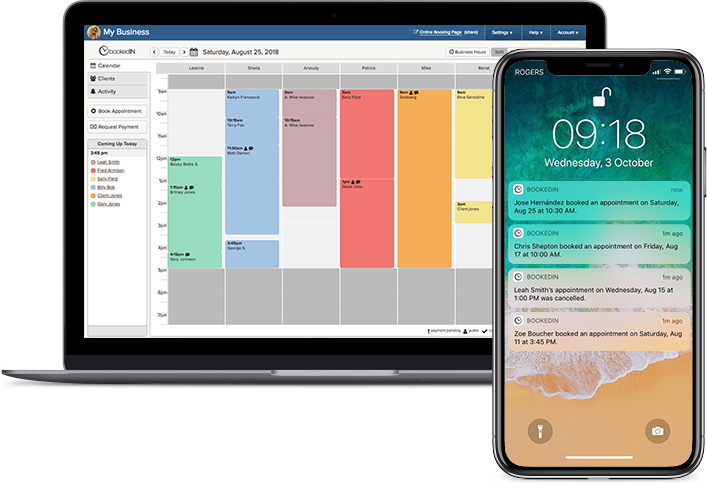
With tools like automated reminders, calendar syncing, payment collection, and more.
How To Say No to Customers or Clients: 12 Ways To Decline Requests
Below are the most effective tips for how to say no to a client politely, plus scripts you can easily use as go-to lines for situations that typically happen across many service business settings.
And the best part? These let you set a clear boundary without ever having to say the actual word “no.”
Some example responses can be used as-is; while others, you might need to adjust the wording to fit your tone or replace the bracketed placeholders with your specifics.
1. Redirect them to what you can do instead
Do this when: The client asks for something you can’t do, don’t currently offer, or can’t accommodate as requested.
Whenever possible, make it a point to offer the next-best option so the client still feels accommodated and you can keep the conversation moving instead of turning into a back-and-forth.
Scripts you can use:
- “We don’t offer that service, but we can do [the closest/next-best alternative service] and get you a similar result.”
- “Right now, I don’t provide that type of work, but I can suggest an alternative that’s similar.”
2. Make it about the schedule or availability, then give options
Do this when: The clients want a specific date and/or time that isn’t open.
When you frame it as “I’m fully booked” instead of “I can’t,” it feels less personal and less negotiable.
Also, it’s best to offer two concrete options so they can choose from there. If you only give one option, it might lead to more counter-suggestions, making the conversation drag longer than it should.
Scripts you can use:
- “That time’s already booked. We can do either [two schedule options]. Which one works better for you?”
- “Unfortunately, that slot’s taken, but I have [one option] and [other option] available. Which would you prefer?”
3. Point to your policy as a reminder
Do this when: The client is trying to negotiate about late cancellations, refunds, or rescheduling rules.
Leaning on your shop policies is a smart way to prove to clients that a decision isn’t personal and that you’re simply following a standard that applies to everyone.
Scripts you can use:
- “That’s outside our cancellation window, so the [fee/deposit] applies. If you’d like, I can help you reschedule for the next available.”
- “We’re not able to offer refunds once the service has been provided, but I’m happy to talk through what didn’t feel right and see what we can do to make it right.”
Put your policies on autopilot with Bookedin
4. Stick to what was scheduled & offer a follow-up
Do this when: The client has an additional request that would make the appointment run significantly longer than the time they reserved.
It’s important to set boundaries when it comes to last-minute changes or add-ons, especially when you have another client booked right after.
Scripts you can use:
- “We can definitely do that. It just needs its own time since we don’t have enough time now. Want me to book a follow-up appointment for it?”
- “To keep the quality up and the schedule on track, we’ll have to do that extra during another appointment. What do you think?”
5. Offer an option that better suits their budget
Do this when: The client asks for a discount or to “match” another price.
Avoid debating with the client about your pricing or letting them haggle. Instead, offer some budget-friendly options — whether that’s a smaller service, shorter session, or less expensive package deal.
Scripts you can use:
- “We’re not able to discount that service, but I can recommend an option that fits your budget.”
- “That service is priced as listed. However, you can tell me your budget, so I can suggest what will work.
Also read: How To Talk About Money With Clients (Without Feeling Awkward)
6. Reset their expectations and offer a realistic plan
Do this when: The client expects results that look exactly like their peg (but aren’t possible), or extreme changes that don’t match their starting point or budget.
In such cases, it’s best to be honest early on and guide them toward what’s actually possible. You can still sound confident and qualified while avoiding promises you can’t control.
Example responses:
- “We can aim for that direction, but we’ll need to adjust the plan a bit to match your budget and the time we have today.”
- “Based on your starting point, that exact result isn’t realistic in one session — but here’s what is doable.”
7. Remind them that faster may mean lower quality
Do this when: The client wants you to speed through, skip steps, or do something you know would compromise the result.
Sometimes, you’ll get clients who expect magic-wand-like results for a service they didn’t think would take that long. It’s important that you don’t agree to rush or cut corners, as that could create bigger issues later — be it unhappy clients, refunds, or bad reviews.
If they still insist because they really are in a hurry, offer a simpler option that fits the time.
Scripts you can use:
- “I’m not able to rush this without risking the quality. If you need something quicker, we can switch to [simpler option] and it’ll still look great.”
- “To do that right, we’d need more time. Are you fine with that, or do you want to go with [simpler option] that I can realistically do faster?
8. Require a consultation (or more info) before you commit
Do this when: The client asks for an exact price, time estimate, and/or plan, but you don’t have all the details confirmed yet.
When it comes to this kind of situation, you either ask the client to come in for a consultation or have them answer additional questions. That way, you have more information before giving any definitive answers.
Scripts you can use:
- “I can’t confirm that accurately without seeing it in person. Let’s book a quick consult so I can give you a clear answer.”
- “I can give you a ballpark, but if you want the exact price, I’ll need to see the [hair/skin/design/etc.] first.”
Also read: Appointment Reminder Templates To Use for Your Service Business
9. Keep communication boundaries & move the conversation to the right channel
Do this when: The client is messaging across multiple channels that aren’t part of your normal booking process, or they’re expecting you to reply instantly 24/7.
Sticking to one booking channel keeps changes, payments, and confirmations organized. It helps prevent double-bookings or missed details, and it stops clients from expecting round-the-clock replies.
Scripts you can use:
- “For anything booking-related, please visit our booking page or contact us at [official email/phone number]. That way, nothing gets missed.”
- “To keep it fair and organized for everyone, we don’t do after-hours booking over text or DM, but you can book or make changes through our booking link so everything’s confirmed.”
The best way to handle appointments & classes
Let clients grab a spot on your calendar anytime, so you're not stuck handling bookings.
10. Set a firm boundary on behavior & end the conversation if they don’t comply
Do this when: The client is being rude, threatening, or repeatedly pushing even after you’ve given them a clear warning.
You can be polite and professional without tolerating rude or aggressive behavior. Also these situations, shorter is better; longer explanations might just give them more to push against.
Scripts you can use:
- “I’m happy to help, but I need the conversation to stay respectful. If it can’t, I’m going to end it here.”
- “I understand you’re frustrated, but I just need us to keep this conversation respectful so we can sort this out.”
11. Let them know you’re fully booked & offer to keep them in the loop
Do this when: Your schedule is full, and you don’t have room to take new clients for that service without burning out or falling behind.
It’s best to be honest about your availability and pause new bookings in the meantime.
However, you should still keep the door open for future bookings. Also, consider offering a waitlist (especially if it’s not unusual for others to cancel) so that the client won’t feel like they’ve hit a dead end.
Scripts you can use:
- “I’m not taking new clients for that service right now, but I can add you to the waitlist if you’d like.”
- “Unfortunately, we’re fully booked for that service at the moment. If you’d like, tell me your availability and I’ll reach out if a spot opens.”
12. Admit it’s “not your lane” & recommend the right person
Do this when: The request is outside your specialty, you’re not confident you can deliver the results the client wants, or it simply doesn’t fit your style of work.
It might be tempting to say yes anyway, but that’s how you end up with mismatched expectations and a client who leaves disappointed. Being upfront can actually build trust because it shows you care more about the result than the sale.
If possible, you should redirect the client to someone else — whether it’s another person on your staff or a different service provider in the area.
Scripts you can use:
- “I’m not the best fit for that specific request, but I’d be happy to point you to someone who specializes in it.”
- “That type of work is a bit outside my lane, but I don’t want to leave you hanging. So, I can share a few names of people who I trust and do that regularly.”

Quick-Reference Guide for How To Say No to a Client
Here’s a quick recap of all 12 scenarios, along with what to do and what to say (trimmed down from the full example responses above) for each.
| Situation | What to do | What to say (trimmed version) |
|---|---|---|
| They want a service you don’t offer | Redirect to your next-best option | “We don’t offer that, but we can do [alternative] and get you a similar result.” |
| The time they want is taken | Make it about the schedule, then give two options | “That time’s booked. We can do [option A] or [option B], which works better?” |
| They’re negotiating cancellations or refunds | Point back to your policy | “That’s outside our cancellation window, so the [fee/deposit] applies.” |
| They tack on extra work mid-appointment | Stick to what’s booked, offer a follow-up | “We can definitely do that, it just needs its own time. Want me to book it?” |
| They ask for a discount or price match | Offer a budget-friendly option instead | “We can’t discount that, but I can recommend an option that fits your budget.” |
| They expect unrealistic results | Reset expectations, give a doable plan | “That exact result isn’t realistic in one session, but here’s what is.” |
| They want you to rush the job | Note that cutting corners affects the result | “I can’t rush this without risking the quality, but we can switch to [simpler option].” |
| They want a firm quote but haven’t provided details | Require a consult first | “I can’t confirm that accurately without seeing it, so let’s book a quick consult.” |
| They message everywhere and expect instant replies | Move it to your proper channel | “For anything booking-related, please use our booking page so nothing gets missed.” |
| They’re being rude or aggressive | Set a behavior boundary, end if needed | “I’m happy to help, but I need the conversation to stay respectful.” |
| You’re fully booked | Be honest, offer a waitlist | “I’m not taking new clients for that right now, but I can add you to the waitlist.” |
| The request is outside your specialty | Admit it, refer them out | “I’m not the best fit for that, but I’d be happy to point you to someone who is.” |
Make Boundaries (& Saying No) Easier With Bookedin
Remember that saying no isn’t necessarily a sign of bad customer service. Sometimes, it’s what helps you protect the quality of your work, keep things fair for every client, and save your own sanity.
Also, if you’re ever still in doubt about how to say no to a client, just remember that your response should always be these three things: clear, considerate, and consistent.
Lastly, if you want to lessen the chances of such conversations in the first place, you should have a system that makes your policies easy to spot and your appointment booking process crystal clear.
That’s where Bookedin helps. It essentially does all the explaining for you, so clients aren’t guessing (or asking for exceptions), and you and your staff get to have more time doing actual work.
Keep your business organized & booked solid
Everything you need to manage your schedule in one place.
- ✓ Take deposits
- ✓ Automatic reminders
- ✓ Calendar sync
- ✓ Mobile-friendly booking
FAQ About How To Say No to Customers
How do you politely say no to a client?
The trick is to avoid telling them “no” outright as much as possible, and lead with what you can do instead.
Acknowledge the request, give a clear reason if it helps (like your schedule or policy), and offer an alternative (such as a different time, a smaller service, or a referral).
How do you deal with a client who won’t take no for an answer?
Keep your response short and don’t over-explain. Long justifications just give a pushy client more to argue against.
Restate your boundary once, plainly, and communicate that the decision isn’t up for debate. If they keep pressing or turn rude, it’s fair to end the conversation with something like, “I'm happy to help, but I need this to stay respectful.”
Should you explain why you’re saying no?
You can, but you don’t have to. Giving a short reason might help, since it shows the decision isn’t personal, but typically, you don’t owe anyone a detailed justification.
Keep the explanation brief and matter-of-fact, because the more you over-explain, the more it sounds like the decision is negotiable. When in doubt, give the reason once, then pivot to what you can offer instead.
How do you say no to a regular or long-time client?
Use the goodwill you’ve already built, but don’t bend the rule just because you know them well. Acknowledge how much you value their loyalty, be honest about why you can't do what they’re asking, and offer the best alternative you’ve got.
Is it okay to turn down a client request?
Yes, absolutely. Turning away a client doesn’t always mean bad customer service. Oftentimes, it’s what protects the quality of your work, keeps things fair for your other clients, and saves you from burnout.
Taking on requests that are unrealistic, outside your specialty, or against your policies usually leads to mismatched expectations and unhappy clients anyway. A thoughtful, well-handled no can actually build more trust than a reluctant yes.
What do you say when a client asks for a discount?
Do not debate your pricing. Offer a smaller or simpler service that fits their budget instead, like: “That service is priced as listed. If you have a specific budget, I can suggest options that work within it.”
This sidesteps the negotiation and keeps the conversation productive
When should you fire a client?
When they repeatedly ignore your policies, disrespect your staff, or create a disproportionate amount of stress for the revenue they bring.
Be direct, professional, and brief. You can say something like: “We are not going to be the right fit going forward. I wish you well.”
You do not owe a detailed explanation.
About the Author

With over a decade of experience across startups, online publications, and agencies, Marcy is all about delivering content that connects brands with the audiences they're trying to reach.