How To Say No to a Potential Client
Turning down someone looking to book your services usually isn’t easy, especially when you want to be helpful and maintain a professional image. But in many cases, saying yes to every single booking request can do more harm than good.
That’s why knowing how to say no to a potential client is an important skill, particularly if you’re a service business owner or manager.
In this article, we’ll walk through when it makes sense to decline and how to do it the right way. We’ve also included example scripts so you can better guide your staff in figuring out what to say in common situations.
Valid Reasons To Turn Down a Would-Be Client
Below are the most common legitimate reasons for a service business to refuse a potential client or booking request.
- Not aligned with what the business offers: The client’s request involves a different style, approach, or type of provider that falls outside of the business’s services or specialization.
- Scheduling constraints: The business may be fully booked, short on capacity, or unable to meet the requested turnaround time.
- Budget mismatch: The client’s budget is far below the minimum feasible rate for the work they want.
- Inappropriate or disrespectful behavior: Sometimes a prospective client shows signs of being difficult to work with — such as rude communication, discriminatory comments, or disregard for clearly stated policies.
- Safety or security concerns: You can decline if the client’s request involves unsafe conditions, threatening behavior, or potential harm to people or property.
- Unclear expectations: The potential client is unable or unwilling to define what they want, or is showing signs of being unusually difficult to please.
- Concerns about payment reliability: The potential client refuses to pay a deposit, pushes back on payment terms, has a history of chargebacks, or raises other financial red flags.
- Conflict of interest: Taking on the client could create a conflict with the business’s responsibilities to an existing client, partner, employer, or other professional obligation.
- Ethical concerns: This typically means the request might require you or your staff to act in a way that feels misleading, dishonest, harmful, or otherwise misaligned with your professional values.
- Location or service-area limits: The travel distance, time, or logistics make it impractical for you to take on the booking request.
- Compliance or legal issues: This means the request could potentially violate licensing rules, insurance requirements, health regulations, contract terms, or other legal obligations.
Also read: How To Handle Difficult Clients & Avoid Negative Reviews
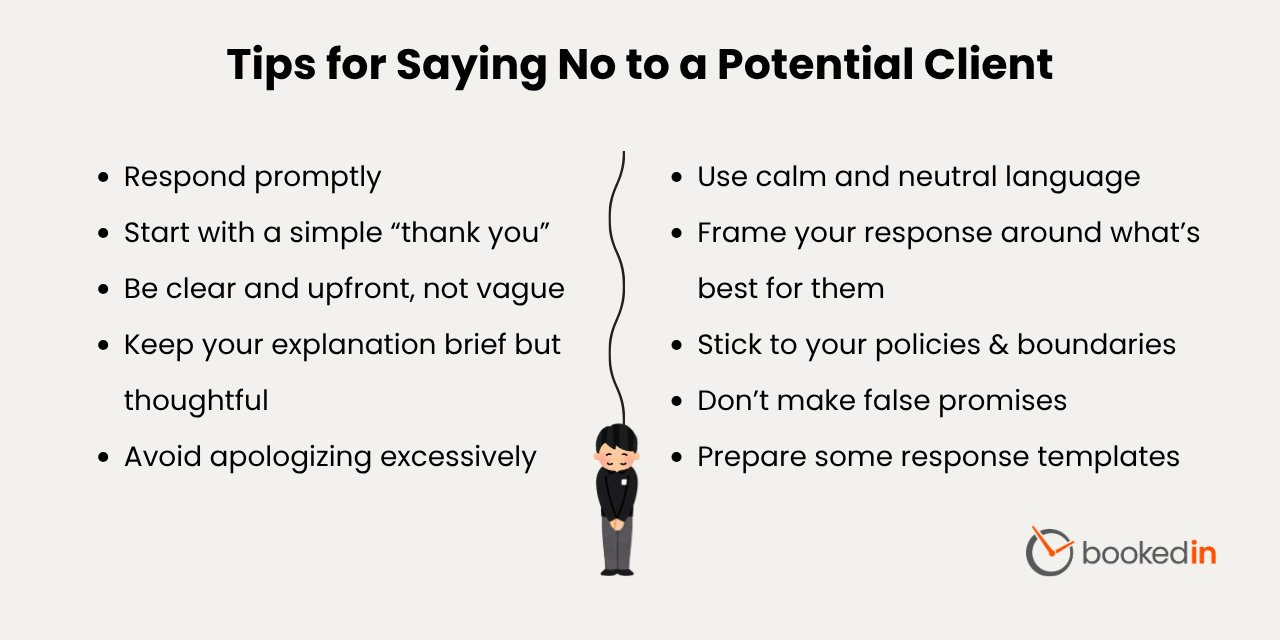
10 Tips for How To Say No to a Potential Client Tactfully
Learning when and how to say no to a potential client doesn’t mean that you have to come across as cold or dismissive.
So, let’s go into some practical tips and ways you can go about declining to provide your services to a would-be client, while still remaining polite and professional.
1. Respond promptly
Don’t leave someone waiting too long for an answer, especially if you’ve already decided to turn them down. You should aim to respond ideally within one business day, or within 48 hours at the most.
A timely response shows professionalism and that your business respects other people’s time, even when you are unable to accommodate them. It also allows the person to move forward and look for another option without unnecessary delay.
Make it easier to accept the right client bookings
Review booking requests, set your availability, and get better control over your schedule.
2. Start with a simple “thank you”
Acknowledging that the person took the time to reach out and considered your business can go a long way in setting a respectful tone. It also prevents you from coming off as dismissive.
In many cases, leading with appreciation makes your response feel more considerate, without weakening it.
Also read: 12 Best Ideas for a Client Appreciation Event
3. Be clear and upfront
When saying no to a potential client or booking request, it’s avoid being vague (even if your main goal is to be polite and professional).
That’s because if your wording is too soft or indirect, the person may think there is still room to negotiate or follow up again.
A clear response helps avoid confusion and prevents unnecessary back-and-forth. Don’t think of it as being harsh; rather, you’re just making boundaries easier for these clients to understand right away.
4. Keep your explanation brief but thoughtful
Even though you don’t need to write a long message to justify why you’re saying no, the response should still feel considerate. By this, we mean a short and honest explanation that provides just enough context.
Overexplaining can sometimes make your response sound uncertain or invite the person to argue with your reasoning.
A brief explanation also makes it easier for your staff to communicate refusals consistently, especially if they’re the ones handling inquiries or appointment requests.
5. Avoid apologizing excessively
It’s fine to include a brief apology like, “I’m sorry, we’re not able to take this on.” However, it’s important you avoid repeating your apologies because that can make your response sound hesitant or unsure.
Remember: Being polite is important, but so is having a confident response to communicate that the decision has been made.
6. Use calm and neutral language
Even if the inquiry feels uncomfortable, frustrating, or simply tricky to respond to, it’s important to keep your response professional.
Neutral, respectful wording helps protect your business’s image and prevents the interaction from becoming more difficult than it needs to be. It also keeps the focus on the business decision rather than on personal feelings.
7. Frame your response around what’s best for them
Sometimes, the best way to say no to a potential client is to tell them that another business would be able to serve them better.
If your business cannot realistically deliver the service, timeline, or level of expertise the client needs, it’s often best to say that directly. This helps show that your decision to refuse them is based on what makes sense for both sides.
In some cases, you can also suggest to them another service business that may be a better fit for their needs.
8. Stick to your policies and boundaries
When a request does not align with your business policies or boundaries, it is important to hold that line firmly.
Whether the issue is timing, pricing, travel distance, or booking rules, your response should refer back to your business rules. This shows that your decision is based on established standards, nothing personal whatsoever.
It also helps prevent mixed messages, especially if you’re not the only one handling client inquiries or requests. That consistency gives your staff more confidence in responding, so they wouldn’t be pressured into making on-the-spot exceptions.
9. Don’t make promises you can’t keep
It might be tempting to make your refusal sound gentler by saying something open-ended like “Maybe later” or “Feel free to check back anytime.”
However, if you don’t genuinely mean it, those phrases can lead to misunderstandings or encourage the client to keep following up. If the answer is a straight-up no, it’s best to communicate that clearly so neither of you ends up wasting time.
10. Prepare some response templates for common scenarios
Having a few go-to responses can make it much easier to handle saying no to a potential client, especially if certain types of booking requests tend to come up repeatedly.
Response templates are most useful for service businesses where inquiries may be handled by different team members, not just the owner or manager.
These can help keep your messaging clear and consistent with your policies while also saving time and taking the stress out of figuring out the exact right thing to say in the moment.
Also read: How To Handle Negative Customer Reviews
Sample Responses for Saying No to a Potential Client
Now that you know the best practices, the next step is putting those into words. Here are some ready-to-use scripts to make it easier for you and your staff to decline a client request whenever you need to.
Of course, just make sure to adapt these based on the situation, your policies, and the way your service business normally communicates with clients.
If you want to keep the tone warm and polite:
- “Thank you for reaching out and considering our business. However, we’re not able to take this on at the moment.”
- “We’re glad you thought of us. Unfortunately, we’re not able to accept your request, but we do appreciate you taking the time to contact us.”
- “Sorry, that isn’t something we can accommodate right now, but you’re welcome to check back in a month if you’d like.”
For a more straightforward response:
- “Thanks for getting in touch. Unfortunately, we’ll have to decline your request.”
- “We appreciate you reaching out, but we’re currently not able to take on this [appointment/project].”
When the request isn’t the right fit:
- “Thank you for reaching out. This falls outside of what we currently offer, so we’re not the right fit for this one.”
- “We appreciate your inquiry, but unfortunately, this falls outside the scope of what we’re able to offer.”
- “Thanks for considering us. However, we don’t think we’re the right fit for the budget and scope of this request.”
- “We’re unable to take this on, but I’d recommend inquiring with [Name of other service business], who specializes in this type of service.”
If the issue comes down to availability or policy
- “Thanks so much for reaching out. At the moment, we’re fully booked and not able to take on additional appointments.”
- “We appreciate your interest, but we’re not able to move forward with this request in a way that aligns with our current policies.”
- “Thank you for getting in touch. Unfortunately, this request falls outside our current service area, so we’re unable to take it on.”
If the potential client is being rude or off-putting:
- “We don’t believe this is the right fit for our business, so we won’t be moving forward with your inquiry. Thank you for understanding.”
- “Thanks for reaching out. Based on this exchange, we don’t think we’re the right fit to work together, so we’ll be declining this request. We wish you the best in finding another provider.”
- “We’re choosing not to proceed, as this exchange doesn’t align with how we work with clients.”
Get Better Control Over Client Bookings With Bookedin
Figuring out how to say no to a potential client will probably never be the most comfortable part of running a service business, but it’s a necessary skill to protect your schedule, policies, and the quality of your services.
When a request is not the right fit, the timing doesn’t work, the would-be client shows red flags, or the situation goes against your policies, a firm but polite “no” is the only correct option.
This is also where having the right online scheduling system can make your life much easier.
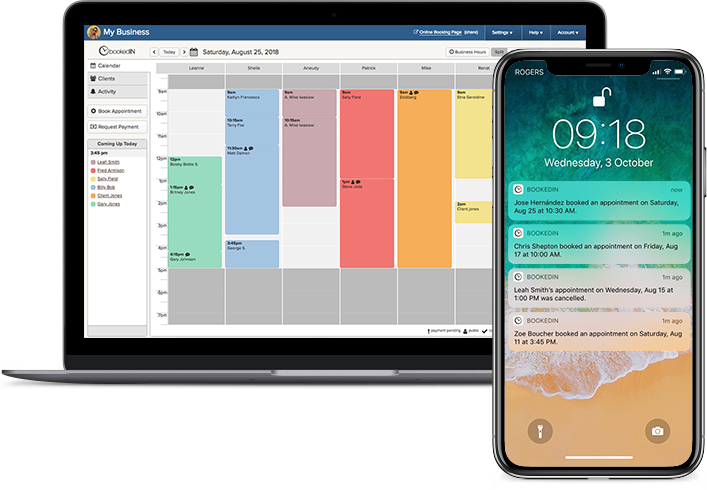
With Bookedin, you can opt to have a booking request form — instead of letting clients automatically pick a time and date on your booking page. That way, you get to screen and decide which appointments, projects, or classes you’ll commit to.
Bookedin also lets you set a booking limit, which controls how far in advance clients can book. This should make it easier to manage your and your staff’s availability, since you won’t be accepting appointments too far out.
Together, these tools can give service businesses more say over which bookings they take on and how their availability is structured.
Book a free demo & see how it works