12 Tips for Successful Barbershop Management
Barbershop management plays a big role in how efficiently your shop runs and how profitable it becomes over time.
Whether it’s about scheduling, client experience, staff training, or something altogether, even the smallest decisions can have a big effect on daily operations.
In this article, we’ll break down practical ways to run a more organized, consistent, and easier-to-manage barbershop.
Barbershop Management Tips & Strategies for Success
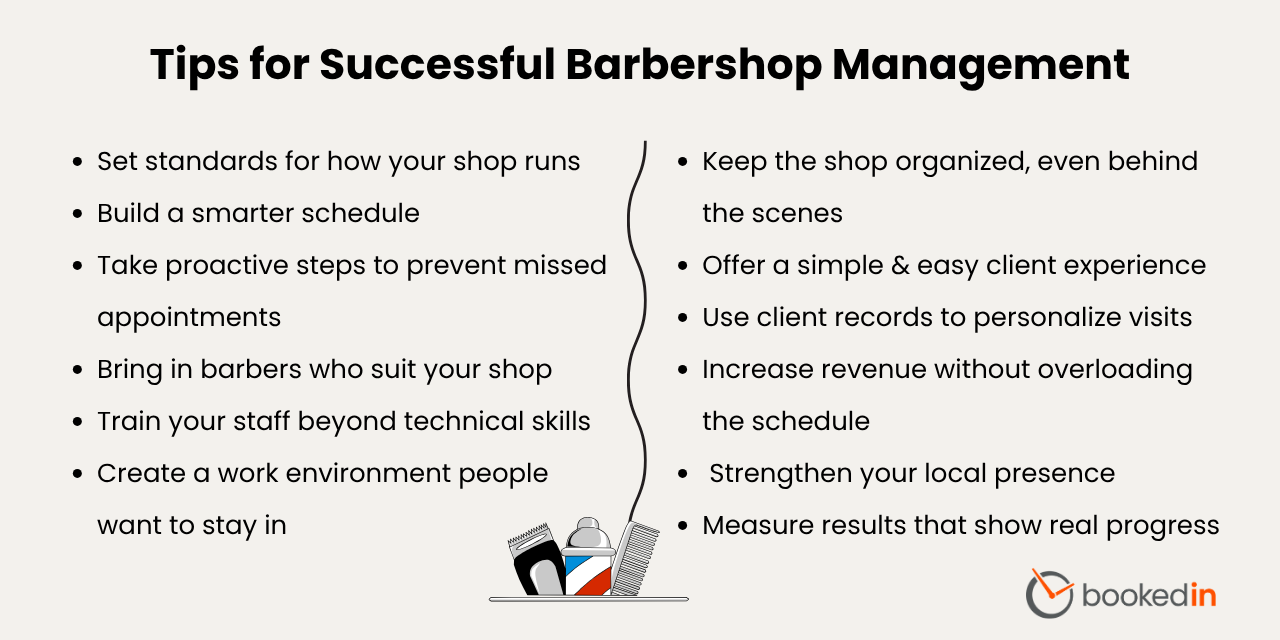
Here are 12 of the most effective ways to improve your barbershop’s efficiency, profitability, and overall growth.
1. Set clear standards for how your shop runs
Good barbershop management starts with knowing exactly how you want the shop to operate.
Clear standards give you and your team something solid to follow, which makes the day-to-day easier to manage. In turn, you’re more likely to provide a consistent experience to your clients.
So, start by deciding what kind of experience you want to be known for. Consider what you want people to associate with your shop — whether it’s sharp, efficient cuts or more premium services with extra grooming add-ons.
Whatever you choose, make sure your services, pricing, policies, and team expectations should all reinforce that same message.
For instance, a barbershop that markets itself as premium should provide an experience that feels polished, consistent and worth the higher price. Alternatively, a shop offering quick, no-fuss cuts should make the rest of the experience just as straightforward.
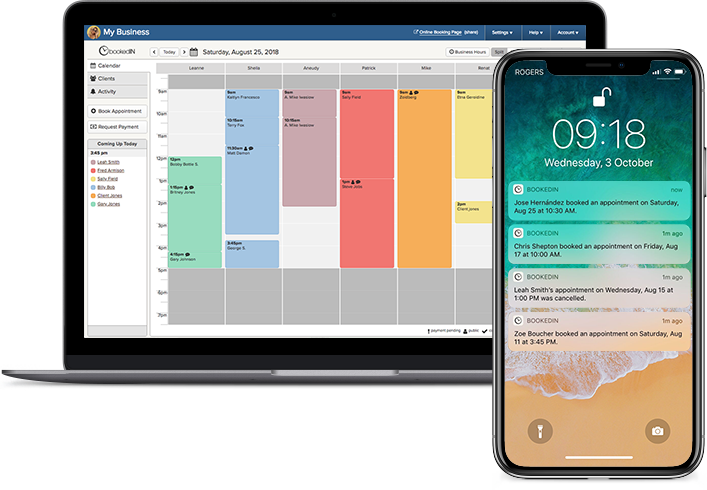
Put scheduling & client info in one system Join thousands of barbers saving time with online scheduling.
2. Build a schedule that keeps the day moving
Even if your barbershop is fully booked and busy, it may still lose money if the schedule is disorganized. Consider this: When appointments are running behind, the staff feels rushed, clients get annoyed, and the whole day starts to feel harder than it should.
That’s why proper scheduling is essential in keeping the day moving at a pace your team can actually handle. Follow these steps to achieve that consistently.
- Use realistic service times: A haircut that usually takes 35 minutes should not be booked as a 20-minute slot just because you want to fit in more appointments. That kind of overstuffed schedule almost always backfires by the middle of the day.
- Don’t be hesitate to add buffer times: A small buffer between certain services (e.g., longer ones) can give barbers a chance to clean up, reset their station, check notes, or simply catch their breath before the next client.
- Set clear rules for walk-ins: Walk-ins can be great for business, but you should decide how your shop handles these during busy periods and how staff should communicate wait times.
3. Take steps to prevent no-shows & last-minute cancellations
No-shows and late cancellations hurt more than most shop owners realize. Besides wasting time and leaving gaps that are hard to fill at the last minute, these can also affect your and your staff’s income.
That said, being proactive about preventing missed appointments is one of the simplest ways to improve your barbershop’s profitability without taking on more work. Below are some ways you can do that.
- Send reminders so clients don’t accidentally forget: You can do this via text or email, and even automate them (with the right scheduling app) so you don’t have to do it manually for each appointment.
- Set a clear cancellation and reschedule policy: Clients should know how much notice you require if they’re going to cancel or reschedule. So, make sure to show this policy on your booking page and in reminder messages
- Require deposits or prepayment for longer or high-demand appointments: These help ensure that the client will show up and not forget (or flake at the last minute), since they’ve already put down some money.
- Use a waitlist and keep track of clients who are open to earlier slots: If someone cancels, you already know who to contact about the opening, instead of letting it go unused.
Also read: Appointment Reminder Templates To Use for Your Service Business
4. Bring in barbers who match your shop’s standards
Hiring the right barber is not just about filling an open chair as quickly as possible.
A strong team makes the shop easier to manage, gives clients a more consistent experience, and helps reduce turnover over time. That said, it’s good to be selective about who joins the team.
Barber skills matter, of course, but those shouldn’t be the only thing you look at. A barber who fits the way your shop runs is more likely to work well with the team, treat clients properly, and stick around.
So, during the hiring process, look beyond portfolio photos and haircut results. Pay attention to whether the person shows up on time, communicates clearly, and seems comfortable enough talking to others.
Also, consider their culture fit. Even a talented barber can create problems if their style, personality, or communication style doesn’t match the experience your shop is trying to offer. Bring in people who can work within your standards and contribute to a strong team environment.
5. Train your staff on every part of the service
In a well-run barbershop, the client experience isn’t just about the haircut itself. Your team (from the barbers to the front desk staff) should also know how to greet clients, handle consultations, explain services, and keep the visit running smoothly from start to finish.
Clients shouldn’t feel like the experience will vary a lot depending on who they book with, so it helps to keep the basics consistent across the shop.
That includes asking the right questions, confirming what the client wants, communicating clearly during the appointment and wrapping things up properly at checkout.
Training should also continue after hiring so your team stays current on haircut trends, product knowledge, and natural ways to recommend add-ons that fit the client’s needs.
Just as importantly, your staff should know how to use your day-to-day systems, including schedules, booking notes, and client history, so the shop stays organized and appointments run more smoothly.
Reduce no-shows and double booking Simple online scheduling tuned for busy shops.
6. Create a work environment people want to stay in
Keeping good staff is often easier and cheaper than constantly replacing them. If you want barbers to stay, the shop needs to feel like a place where people can do good work without unnecessary stress.
Of course, that doesn’t mean everything has to be perfect. It simply means your staff members know what is expected of them and they feel supported by the person running the shop. Below are some tips for how you can keep them engaged and committed.
- Give your staff structure, fairness, and respect: Fair scheduling, clear responsibilities, and basic respect in daily interactions go a long way here. Barbers are more likely to stay when they feel like they are being treated like professionals instead of being left to figure everything out on their own.
- Recognize great work constantly: This can be as simple as giving credit for strong client feedback, praising improvement, or thanking someone for handling a busy day well.
- Make communication part of the routine: If staff only hear from management when something goes wrong, tension tends to build quietly. Regular check-ins, quick team huddles, or short one-on-one conversations can make a big difference.
7. Keep the shop organized, even behind the scenes
Clients may not notice every behind-the-scenes task, but they are likely to notice the effects when something is off. If supplies are running low, stations are not reset properly, or cleanup falls behind, the day can start to feel rushed and disorganized.
That’s why it helps to keep a close eye on everyday essentials like tools, towels, capes, disinfectant, and retail stock, while also setting clear expectations for how stations should be cleaned and reset throughout the day.
You don’t need an overly complex system, but you do need a routine that you and your staff actually follow.
This helps barbers move into the next service with less scrambling and less wasted time. In turn, clients get a smoother experience without seeing all the work that made it possible.
8. Simplify the client experience from booking to checkout
Clients are more likely to come back when every part of the appointment feels seamless, convenient, and pleasant, not just the service itself.
The easier you make the whole client experience, the less likely people are to look at another barbershop next time. The following steps should help you out.
- Smooth out the booking, check-in, and checkout process: If booking an appointment feels complicated, check-in is confusing, or checkout takes longer than it should, clients are less likely to return and book again.
- Make your services and pricing easy to understand: From the moment they start booking their appointment, clients should be able to instantly find out what a service includes, how long it takes, and how much it costs.
- Set up a welcoming atmosphere: Clients notice things like how they’re greeted, whether the waiting area feels looked after, how loud or chaotic the space feels, and whether wait times are handled well. The main goal is to make people feel comfortable and confident that they’re in good hands.
Also read: 8 Effective Ways To Keep Your Clients Coming Back
9. Use client records to personalize repeat visits
Client notes, preferences, and appointment history can make repeat visits run more smoothly and feel more personal. These not only help save time during the appointment, but also show clients that your shop pays attention.
Instead of asking the same questions every time, your team can quickly look back at what the client usually gets and what they prefer. That might include haircut details, beard preferences, product choices, or anything else they regularly mention.
Keeping client notes are especially helpful when a client books with a different barber, since the next person can still see what was done before. This helps ensure they get consistently good service and prevents miscommunication.
10. Bring in more revenue without squeezing in more appointments
In many barbershops, there’s more room to increase revenue by making each appointment a little more valuable. This strategy is often easier on the team than trying to fill in more timeslots into an already full schedule.
One way to do that is by offering add-ons that make sense for what the client initially booked — not like random extras added for the sake of it. This can include beard services, scalp treatments, hot towel finishes, or styling products.
The same goes for upselling in general. When you pay attention to what the client wants and recommend something based on their actual needs, upselling feels more helpful and not pushy.
Additionally, make sure to review your pricing regularly. If your costs have gone up, demand has increased, or your service quality has improved, your prices should reflect that. Otherwise, you may be working just as hard without earning what the service is really worth.
11. Strengthen your local presence to attract clients
You don’t need a complicated marketing plan to keep your barbershop visible. More often than not, getting consistent bookings comes down to making a good impression and proving to people why they should trust and recommend your shop.
Below are simple, practical ways to bring in new clients while also reminding people why your barbershop is worth coming back to.
- Encourage happy clients to leave reviews or testimonials: A lot of satisfied clients are willing to share positive feedback. Reviews help improve your visibility and credibility on platforms like Google, while testimonials give you useful quotes you can share on your website or social media.
- Give referral incentives: If a client already likes your service, a simple incentive can give them one more reason to recommend you to a friend. This can be as simple as a small discount or service credit.
- Keep your business details up to date online: Your shop hours, services, prices, contact details, and booking link should be easy to find and accurate everywhere clients might look. That includes your Google Business Profile, website and social pages. If someone has to dig for your information or they find conflicting details, they may move on to another barbershop instead.
Also read: 14 Barbershop Marketing Ideas To Get More Clients
12. Track the numbers that show whether your shop is improving
Looking at a few key numbers can help you spot what’s working, where problems are starting to show up, what needs to be fixed, and what you should focus on next.
After all, good barbershop management is about checking performance regularly and adjusting as the business changes — not just setting things up once and hoping for the best.
- Keep an eye on retention, rebooking, and no-show rates: These numbers are often more useful than revenue alone when you’re trying to understand long-term performance. They also help you see whether the systems you have in place are actually building repeat business.
- Measure average ticket and barber productivity: The former helps you understand how much revenue each client is bringing in, while the latter helps you see how effectively each barber’s time is being used. Together, these numbers can show whether growth is coming from better pricing, stronger add-ons, fuller schedules, or a mix of all three.
- Adjust your systems based on what the data shows: The point of tracking the numbers mentioned above is to use them to make better decisions about how the shop runs. Low rebooking may mean the checkout process needs work, while high no-shows can point to issues with reminders or cancellation policies. If average ticket stays flat, it may be time to review your add-ons, pricing, or service recommendations.
Also read: What To Say to No-Show Clients (Including Message Templates!)
Make Barbershop Management Easier With Bookedin
Running a more efficient and profitable barbershop usually comes down to these four things: clear standards, a dependable team, tight systems, and an experience clients trust enough to return to.
Of course, you don’t need to make changes all at once based on the barbershop management tips we mentioned above. It often makes more sense to start with the biggest pain points first, then improve from there.
Small changes in the right areas can have a bigger impact than trying to overhaul everything at once.
And if you want to make those improvements easier to manage, using the right appointment scheduling software can help. Bookedin gives barbershops one place to handle online booking, reminders, client notes, and more — all without adding extra admin work.
Make it easy for clients to book Let clients book a time and confirm instantly — no back-and-forth. Your schedule stays full, and you spend less time replying.
Get started→
FAQ About Barbershop Management
What is barbershop management?
Barbershop management is the process of running the business side of a barbershop. That includes things like scheduling, staff management, customer service, pricing, inventory, marketing, and keeping daily operations organized.
In simple terms, it is about making sure the shop runs smoothly for both your team and your clients. Good barbershop management also helps improve efficiency, retention, and long-term profitability.
How do you manage a barbershop successfully?
Managing a barbershop successfully means keeping both the business and client experience running smoothly.
That includes setting clear expectations for staff, staying on top of scheduling, reducing missed appointments, and making sure clients get consistent service.
You also need to pay attention to things like pricing, rebooking, and day-to-day operations so small problems do not turn into bigger ones. The goal is to build a shop that feels organized, dependable, and worth coming back to.
What are the biggest challenges in barbershop management?
Some of the biggest challenges include no-shows, last-minute cancellations, inconsistent service, staff turnover, and keeping the day running on time.
Many shop owners also struggle with pricing, rebooking, and making sure the customer experience stays consistent across the team.
On top of that, small behind-the-scenes issues like poor inventory habits or unclear policies can create bigger problems over time.
Managing a barbershop well usually means staying ahead of these issues before they start affecting profit or retention.
How many haircuts can a barber do per day?
That depends on the type of services offered, the barber’s speed, and how the schedule is set up.
In many cases, a barber might do around 8 to 15 haircuts a day, but the number can be lower for longer, more detailed services or higher in a fast-paced shop with shorter appointments.
Walk-ins, buffers, breaks, and add-on services also affect how many clients can realistically be seen. The main thing is to avoid overloading the schedule so quality does not drop.
Can you run a barbershop even if you’re not a barber?
Yes, you can run a barbershop even if you are not a barber, as long as you understand the business side and follow local licensing rules.
Many owners focus on management, staffing, operations, and marketing while licensed barbers handle the services themselves.
That said, you still need a solid understanding of how the shop works day to day so you can make good decisions. It also helps to listen closely to your team, since they are the ones working directly with clients.