How To Get Clients as a Personal Trainer
Between planning programs, running sessions, and maybe even traveling between clients, finding new people to train can easily fall to the bottom of your list.
Still, knowing how to get personal training clients effectively helps you keep a steady stream of bookings, which makes your income a lot more predictable.
This guide is mainly for independent personal trainers, whether you hold sessions at clients’ homes, outdoors, in rented gym space, or in your own studio.
That said, if you’re employed by a gym or coach clients online, you’ll still find plenty here that applies to you.
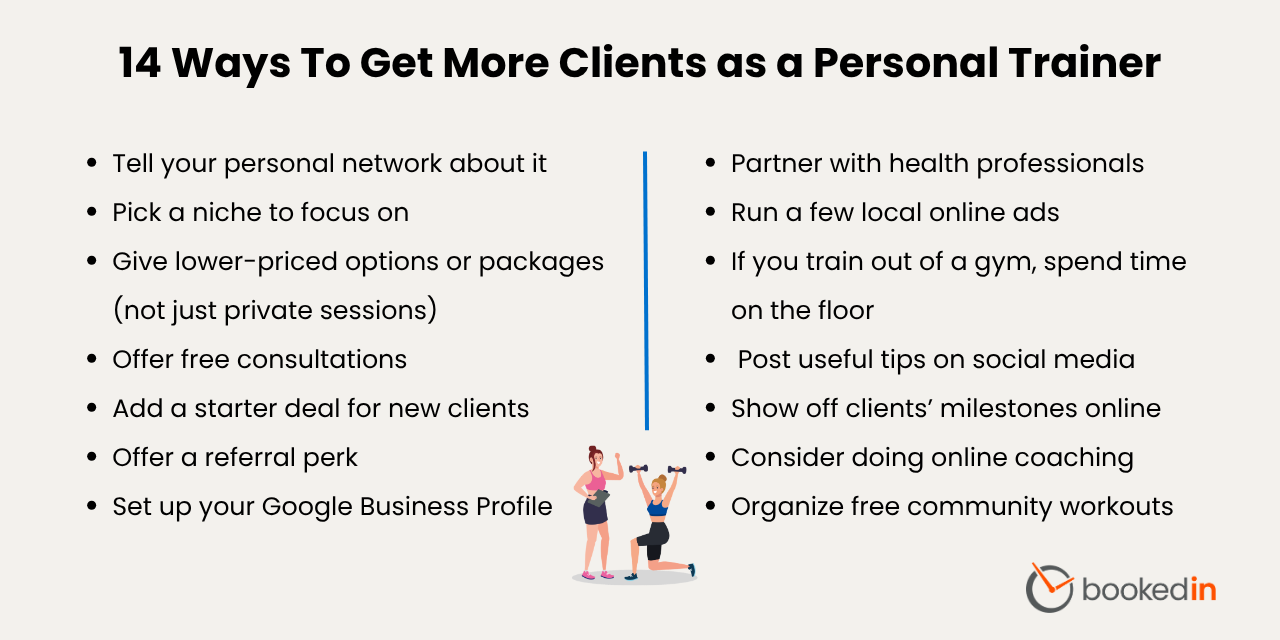
14 Tips on How To Get Personal Training Clients
Now, let’s cover how to get clients as a personal trainer from a few different angles: reaching out to people you already know, setting up low-commitment offers, building a local client base, and attracting new clients online.
You don’t have to go through the tips in the exact order below. Feel free to start with the ones that best fit your current situation.
1. Tell your network that you’re taking on clients
This is especially important if you’re just starting out as a personal trainer. Chances are, your first clients will be people you already know or those who know someone you know.
They’re more likely to trust you than a stranger would, so it can take less convincing to get them to book a consult. These can be your friends, family, former coworkers, and people from your gym or running club.
Overall, the goal is to let them know you’re now working as a personal trainer — or, if you’re not new to this, that you have room for more clients.
So, don’t just post one announcement on your socials and hope the right people see it. Send a short personal message to your contacts. You can reuse the same one and tweak it a little for each person. Here’s an example:
Hey [Friend’s Name]! I’ve started my own personal training business, and I’m taking on new clients. I can meet at your home, a nearby park, or my studio, depending on what works for you.
If you or anyone you know is interested, I’m happy to start with a free intro session. You can book a time here: [link to your booking page]

Take client bookings around the clock
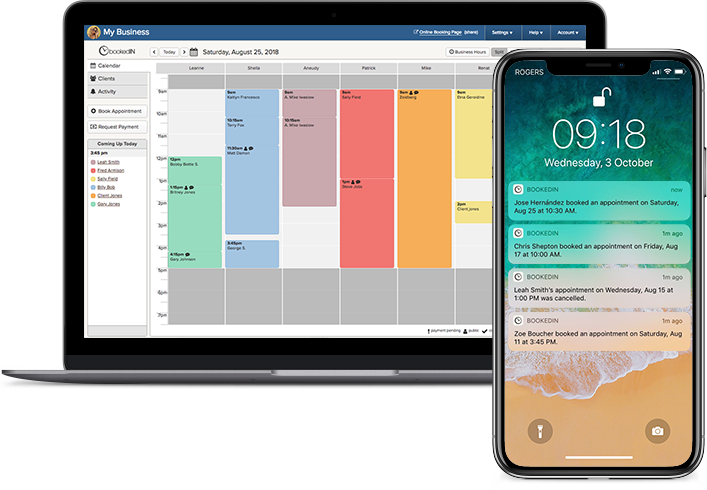
Clients can check your availability and book a slot on their own. No need for you to message back and forth.
2. Pick a niche to build your marketing around
This means a specific type of client you know how to train well and want to work with more.
It could be new moms getting back into exercise, adults 55 and older who want to stay strong and mobile, runners who want to add strength training, or complete gym beginners.
Think about the clients you already enjoy training and the ones you have experience with or certifications for. If you’ve played soccer for years, then you might want to focus on training young athletes who want to get faster and stronger.
Having a niche also makes it easier for other people to recommend you. For example, if you’re known for training runners, someone can easily pass your name along to a friend who’s preparing for a half marathon.
That doesn’t mean you have to turn away anyone outside your niche; you can still train whoever books with you. Having a niche just helps potential clients figure out quickly whether you’d be the right trainer for them.
3. Include a lower-priced option alongside one-on-one sessions
Many personal trainers offer one-on-one or private sessions, but the price can be a lot for someone who’s still deciding whether personal training is worth it.
With a lower-priced option, those hesitant clients can start training with you sooner without having to commit to the full cost right away.
Semi-private sessions (two or three people training together) and small group sessions let you charge each person less while earning the same or more per hour.
For instance, if your one-on-one rate is $80 a session, a semi-private one with three clients paying $40 each brings in $120 for that same hour.
You can also offer packages and monthly plans. Clients either buy a set number of sessions upfront at a discount (say, 10 for $700), or pay a fixed monthly amount (like $300 for four sessions).
4. Offer a free consultation that clients can book online
Most people want to see what training with you would actually be like before they pay for sessions. That’s why a free initial consultation or intro session is a natural first step.
Make sure you clarify how it’ll go, so potential clients know what to expect. It can start with a chat about their goals, followed by a quick movement assessment, and then maybe a short sample workout.
It also helps to let people book the consult online instead of having to message you first and wait for a reply. That way, someone who’s ready to take the first step can grab a time right away, even when it’s after hours or you’re busy with other clients.
Note: With Bookedin, you can list your consultation as its own service on your booking page and use custom service hours to control when it’s available. You can also set up automated text and email client reminders.
5. Put together a starter package for first-time clients
Even if the consult or intro session turned out well, some people may not be ready to sign up for a 12-week plan or a 10-session package. A short starter package (e.g., four sessions over four weeks) lets them ease into training with you regularly.
Spell out exactly what’s included: how many sessions, how long each one is, where you’ll meet, and whether you’ll check in on them between sessions. That way, clients know exactly what they’ll be paying for.
6. Give existing clients an incentive to recommend you
Once you have a few clients, some of them may have already mentioned you to their friends. So, why not offer a referral perk that’ll encourage them to spread the word about you even more?
Make sure your referral perk applies to that friend too, so they have a reason to actually book with you. One simple option is to offer both people a free session once the friend signs up.
Another is a bring-a-friend workout, where a client brings someone along to a session at no extra cost. That way, the friend gets a feel for how you train, and having someone familiar there can make the first session less awkward or intimidating.
Also read: How To Make Your One-Person Business Look More Professional
7. Set up a Google Business Profile for your personal training services
Your personal network might run out at some point, which is normal. But by then, you’ll also want people who’ve never met you to start coming across your name.
This is when building a local client base comes into play, and one of the most effective ways to do that is by showing up on local search results.
Think about what you’d do if you were the one looking for a trainer. Chances are, you’d search something like “personal trainer near me” on Google and check out the first few results
Many of those names appear on a map at the top of the page. To have a shot at showing up there, you’ll need a Google Business Profile. It’s free to set up, and filling it out completely can help you rank higher in local searches.
Pick “Personal trainer” as your main category, then put your address, services, hours, and a short description mentioning your niche. Also, add a few photos of you training clients and a link to your online booking page.
8. Connect with health professionals who can refer clients to you
Physical therapists, chiropractors, dietitians, and massage therapists often work with people who could use a personal trainer.
For instance, a client who’s finishing physical therapy for a knee injury may want someone to guide their strength training once they’ve been cleared to exercise on their own. To start, reach out to two or three local practices you’d be comfortable recommending.
Introduce yourself, explain who you train, and offer to send your own clients their way when they need help you can’t give (e.g., a client dealing with ongoing back pain). From there, here are a few ways you can help each other out:
- Offer them a free session. It’s easier for someone to recommend you once they’ve seen firsthand how you train.
- Leave business cards at their front desk. Also, ask if you can keep a few of theirs at your studio or in your gym bag, so you can return the favor.
- Give their clients a perk. For example, offer anyone they send your way a free intro session or a discounted starter package. You can even print the offer on the back of your business cards.
- Host something together. This can be a free workshop with a physical therapist on staying strong after an injury, or with a dietitian on eating to support training. That way, you each get to meet the other’s clients.
9. Run a few local ads online
Ads can help you reach people nearby who haven’t heard about you or don’t know much about you yet.
One option is Meta ads, which run on both Instagram and Facebook, and let you target people within a few miles of where you train. That way, you’re not paying to reach people who live too far away to book.
As for what to advertise, it helps to lead with an easy first step, like a free intro session, your starter package, or an upcoming community workout. The ad can be a short clip of you demonstrating an exercise or talking about what makes your approach different.
Start with a small daily budget (think $10 to $15) and give the ad a couple of weeks before deciding whether it’s working. Don’t forget to keep track of how many bookings come from your ads, too.
One app for private sessions, classes, & everything in between
24/7 client scheduling, automated reminders, customizable booking forms, and more.
10. If you train out of a gym, spend time on the floor
This one’s mainly for trainers who rent space at a gym or are employed by one. Spending time on the gym floor helps members get to know you, which makes it more likely they’ll think of you when they want a trainer.
But first, check the gym’s rules. Some gyms don’t let independent trainers approach members, and that’s often written into the rental agreement.
If you’re allowed, here are some tips on how to do that without risking making people uncomfortable:
- Let people come to you. Say hi to regulars, re-rack weights, and help when someone’s clearly looking for a machine or piece of equipment. You could also offer a free form check (with the gym’s permission) at a set time each week, so members know when and where to find you.
- Pick the right moment. Only approach during natural pauses, like between sets or when someone’s looking around. Don’t interrupt someone mid-set or wearing headphones.
- Ask before giving a tip. You can say something like “Want a quick pointer on that?” and if they say no, take it at face value.
- Keep comments only about the exercise. Never comment on someone’s body or appearance.
- Give one tip, and leave it at that. Don’t pitch sessions in the same conversation. If they’re interested, they’ll ask what you do.
11. Post helpful content that answers common fitness-related questions
Your social media and online presence can also reach people nearby who haven’t heard of you yet. A good way to win them over is by posting content that answers questions they probably have about fitness and working with a trainer.
Someone who’s never done weightlifting might want to know how to use the machines without looking out of place, while someone with a busy job might be wondering if 30-minute workouts are enough to see progress.
So, turn those questions into useful posts. Think short videos showing proper form or carousels that clear up common myths. Explain things the way you would to a friend who’s never worked with a personal trainer.
Add local hashtags and geotag your city or neighborhood, so people nearby are more likely to see your posts. It also helps to mention in your caption what you do and where (e.g., “personal trainer in Brooklyn”), since Instagram’s search looks at caption text, too.
Then, end each post with a short call to action, like “Want help with this? Tap the link in bio.” And, of course, make sure the link in your bio leads straight to your booking page.
12. Show off clients’ progress and milestones on social media
When people see real clients making progress with you, it’s easier to picture themselves doing the same. Before you share anything, though, get your client’s written permission, and let them see exactly what you plan to post.
As for what to share, focus on milestones: a first pull-up, a heavier deadlift, or 12 weeks in a row without missing a session. A short quote or testimonial from the client about how they feel works well, too.
It’s best to leave out body photos unless the client specifically tells you that you can post those. Also, avoid suggesting that anyone who trains with you will get the exact same results, since everyone’s bodies are different.
If they’re up for it, ask clients to post about their fitness progress and invite you as a collaborator (which you can do on Instagram and some other platforms). That way, the post appears on both profiles and shows their followers who’s been training them.
13. Consider doing online coaching for clients you can’t train in person
Online coaching lets you keep working with clients who move away, travel often, or want extra support between in-person sessions.
Usually, it involves a custom program they follow on their own, plus check-ins by video call or message, where they can send you videos of their form for feedback.
Since clients get less hands-on guidance than they would during an in-person private session, you might want to price your online coaching lower.
Online coaching can also be a good fit for people who like how you train and prefer one-on-ones, but can’t afford those regular in-person sessions.
14. Organize free community workouts
Another way to get new fitness clients is to host a free group training or fitness class in a public space (think a park or community center). This would let people get a feel for what your coaching sessions are like.
It could be a monthly Saturday bootcamp, a weekly stretch and mobility class, a beginner-friendly HIIT class, or a warm-up for a local run club.
Whichever you pick, make sure to bring a sign with a QR code that links to your booking page. That way, attendees can book a first session from their phone right then, while they’re still feeling good about the workout.
You can also mention at the end how they can keep training with you, whether that’s a free consult or a starter package.
Keep it short and low-pressure, then share when and where your next free workout event is. Some attendees may want to come back a few more times before booking anything.
Where To Start When Looking for Personal Training Clients
Well, that all depends on how many clients you have right now. If you’re new to this, it’s best to start with the people who already know you, as well as other local professionals who can send clients your way.
On the other hand, if you already have a few clients, give them a reason to bring their friends. You can also focus your efforts on reaching even more people in your local area.
Either way, keep track of which tactics are actually bringing people in. After all, knowing how to get clients as a personal trainer often comes down to learning what works for you specifically.
Easiest way to manage client sessions
Everything you need to run your schedule in one place.
- ✓ Take deposits
- ✓ Automatic reminders
- ✓ Calendar sync
- ✓ Mobile-friendly booking
FAQ About How To Get Clients as a Personal Trainer
How do I get my first personal training clients?
Start with people who already know you, like friends, family, and former coworkers, and let them know you're taking on clients.
A free intro session they can book online makes it easy for them (or someone they know) to give you a try. Once you've trained a few people, a simple referral perk can encourage them to bring their friends along, too.
How do I get fitness clients without working at a gym?
Set up a Google Business Profile so people nearby searching for a trainer can come across you.
You can also connect with local physical therapists, chiropractors, and dietitians who can send clients your way.
Free community workouts in a park or community center are another good option, since people get to try training with you before booking anything
Where can I find fitness clients online?
Instagram and TikTok are good places to share helpful content and client milestones, while a Google Business Profile helps you show up in local searches.
Local Facebook groups and neighborhood subreddits are worth checking too, since people often ask for trainer recommendations there. Just keep your replies helpful rather than salesy, and include a link to your booking page.
How do I get more personal training clients without paying for ads?
Referrals from happy clients, partnerships with local health professionals, and free community workouts don't cost anything beyond your time.
Posting helpful content regularly on social media can also bring in new people over time.
Plus, a complete Google Business Profile is free to set up and can help you show up when locals search for a trainer.
Should personal trainers offer free sessions?
A free intro session or consult can be a good first step, since many people want to see what training with you is like before paying.
As previously mentioned, the key is to give it a clear structure, like a chat about goals, a quick movement assessment, and a short sample workout.
Then, end it with a clear next step, such as a starter package, so interested clients know how to keep going.
About the Author

With over a decade of experience across startups, online publications, and agencies, Marcy is all about delivering content that connects brands with the audiences they're trying to reach.