How To Write a Barbershop Business Plan (With Template & Examples)
Figuring out a barbershop business plan probably feels like homework, especially if you’re doing it for the first time. Plus, most templates you’ll find online are written for pitching to investors, not for the person actually running the shop.
What you need is something you can write in an afternoon and still refer back to six months in. Something that can also help you make decisions once you’re open, not just something you wrote before you started.
In this article, you’ll get a section-by-section structure, an example of what to write in each part, and even a template you can fill in with your own numbers.
What Is a Barbershop Business Plan?
A barbershop business plan is a document covering the practical details of how your shop will work: your services and prices, who your clients are, how appointments get scheduled, what you’ll spend to open, and what you need to bring in each month to stay open.
There’s no required length and no required format for a barbershop business plan. A plan for a single-location shop with three chairs can be just 5 to 10 pages and still do its job.
Another thing to keep in mind is that your business plan is a document you must keep updating every few months; it’s not just a one-time assignment. After all, your prices will change, a barber will leave, and rent will likely go up at renewal.
Do You Need a Business Plan To Open a Barbershop?
No, not legally. You can get licensed, sign a lease, and start cutting hair without ever writing a barbershop business plan.
However, there are three situations where someone else is going to ask you for a business plan, and it’s worth knowing about these before you’re caught off guard:
- A lender is reviewing your application. If you’re going for a small business loan or an SBA loan, they’ll want to see a plan, and they’ll be reading the financial sections closely.
- A landlord is deciding whether to rent to you. Commercial landlords often want proof you can cover rent for the length of the term, especially if you have no track record as a business owner.
- Someone’s investing in your shop or coming in as a partner. A business plan is where you pin down who owns what, who decides what, and how the money gets divided.
Here’s the more honest reason to write one anyway, though. When you sit down and work through the revenue math, you find out whether your prices actually cover your costs.
Plenty of new barbershop owners set their service prices based on what nearby shops charge — only to find out later that those prices don’t leave them much after rent, product, and payroll. Better to know that now than after you’ve already signed a lease.
What To Include in a Barbershop Business Plan
Although there’s no one standard format for a business plan, these are the 11 sections yours should include, in the order they typically appear.
1. Executive summary
Here, you should cover what kind of barbershop you’re opening, where it is, who you’re cutting hair for, and what you expect to bring in during your first year.
Keep it to two to five sentences long, because this is just an overview where you’re giving someone the gist.
Also, it’s best to write this section last, since you won’t have the details straight until the other sections below are done.
Example:
Third Street Barbers is a three-chair neighborhood shop opening in the Eastside district, serving working adults and families who want a good cut without an appointment weeks out.
We’ll offer haircuts, beard trims, and hot towel shaves at $25 to $50, with a projected first-year revenue of $140,000.
2. Shop overview and concept
This section contains the basic facts about your business that someone would need to know before anything else makes sense.
Cover your legal structure (sole proprietorship, LLC, or partnership), the address and square footage, how many chairs you’re putting in, your hours, and the one-sentence version of what kind of shop this is. That last part matters more than it sounds.
A fast walk-in shop turning over cuts in 20 minutes and an appointment-only shop offering straight-razor shaves are two completely different businesses. They need different staffing, different pricing, different hours, and different software.
Example:
Third Street Barbers is a single-location LLC in a 650-square-foot storefront with three chairs, open Tuesday through Saturday, 9 a.m. to 7 p.m. We take appointments and accept walk-ins when there’s room.
3. Services and pricing
List every service you plan to offer, how much you’ll charge for it, and how long it would actually take.
Be honest about the timing for each service. If you write 25 minutes for a haircut that usually takes 35, your daily capacity and revenue projection will both be wrong. Use your real average, and account for the time you’ll spend cleaning up between clients.
If you’re offering combos or add-ons, list them separately with their own price and time.
It’s common to charge slightly less for the combo than you would for both services booked separately, since one longer visit is more efficient for you than two shorter ones.
Example:
| Service | Price | Time |
|---|---|---|
| Haircut | $35 | You absorb it, since the price is locked |
| Haircut and beard trim | $50 | Higher; they know the exact cost before you start |
| Beard trim only | $20 | Depends on your estimate being accurate |
| Hot towel shave | $45 | Small, simple, or repeatable pieces and flash |
| Kids’ cut (12 and under) | $25 | One number decided before the session |
4. Your target clients and local market
This section describes the kind of clients you’re expecting, and whether there are enough of them in your area to keep your chairs full.
Remember to be specific. A vague line like “Men aged 20 to 45” isn’t really a description of anyone, and it won’t help you figure out what your hours or prices should be.
On the other hand, something like “Office workers from the buildings two blocks over” or “Families in the surrounding neighborhood” gives you something to work with and help you make actual decisions.
You don’t need to pay for market research to write this well. Spend an afternoon doing the following:
- Count the barbershops (and even salons) within a mile of your location.
- Note how much each one charges and what hours they keep.
- Look at who lives and works nearby, and whether that’s students, families, office workers, or a mix.
- Check what none of the nearby shops offer, whether that’s weekend hours, kids’ cuts, or the option to schedule ahead online.
Example:
Our primary clients are working adults aged 25 to 50 who live within a 15-minute drive, plus families in the immediate neighborhood. Two of the three nearby barbershops close at 5 p.m. and don’t take appointments (just walk-ins), which leaves evening and scheduled cuts as an open gap.
5. Competitor analysis
Here, you name the barbershops you’re actually competing with and say honestly what they’re good at. Pick the three or four closest to you. For each, write down what they do well, where they fall short, and around how much their services are.
Then, answer the harder question: Why would someone drive or walk past them to come to your shop instead? Maybe you’re open on the hours they’re closed, or you’re better at fades (and you can prove it with your social media content).
Whatever reason/s you land on, a client has to be able to notice it. Putting something like “Better customer service” doesn’t count, since pretty much every business believes that about itself.
If nothing comes to mind, that’s fine. It just means you have another decision to make. Look back at the gaps you found in the section above, then pick one gap to focus your shop on.
Example:
Our advantage: None of the three take appointments, and all three close by 6 p.m. Clients can pick a time online and get seen after work.
| Shop | Distance | Haircut price | What they do well | Where they fall short |
|---|---|---|---|---|
| Classic Cuts | 2 blocks north | $30 | Best fades in the area, strong local reputation | Walk-in only, waits reach over an hour on Saturdays |
| Style Bar | 4 blocks east | $45 | Modern space, full beard and grooming menu | Priced above what most of the neighborhood will pay |
| Sam’s Barbershop | Half mile south | $25 | Cheapest nearby, loyal longtime clients | Closes at 5 p.m., cash only, no website |
6. Marketing plan
This section covers how people will find out your barbershop exists, and roughly how much you’ll spend to make that happen. Focus on the first hundred clients rather than a year-long strategy.
In practice, that usually means a Google Business Profile so you turn up in local searches, an Instagram account showing your work, an opening discount or promo, and asking satisfied clients for a review or testimonial. Put a rough monthly budget for each item (even if the number is zero).
Example:
- Google Business Profile, set up before opening [Free]
- Instagram account posting before-and-after cuts three times a week [Free]
- Flyers at the gym and coffee shop on our block [$80 one-time]
- Opening promo: 20% off for new clients through the first month
- Local social ads [Ongoing, $150 per month]
First-month total: $230, then $150 per month after that.
7. Day-to-day operations
This section explains how the barbershop actually runs once the doors are open, and it’s the one a landlord or lender will read more closely than you’d expect. After all, this is where you show that you’ve thought past opening day.
Cover these practical mechanics:
- How clients get on the calendar (whether that’s phone calls, walk-ins, online scheduling, or all three)
- How walk-ins fit around scheduled appointments without wrecking your day
- Who opens and closes the shop, and what that involves
- How supplies get tracked and reordered before you run out
- What happens when someone cancels late or doesn’t show up (including how much notice you require and whether you’ll ask for a deposit on some services)
[cta_universal_1 badge=”Built for barbers & barbershop owners” title=”A client scheduling app that does the heavy lifting for you” subtitle=”With tools like automated reminders, calendar syncing, payment collection, and more.” button_text=”Try Bookedin” url=”https://bookedin.com/appointment-booking-payment-system-plans-and-pricing/”]
Example:
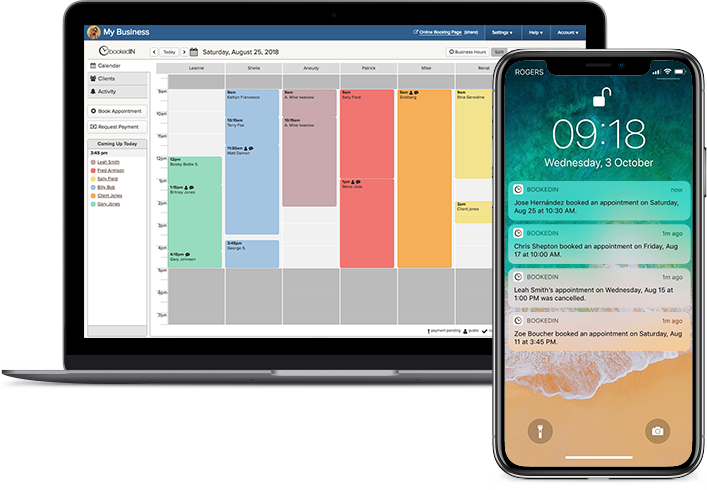
Clients schedule online or by phone, and walk-ins get taken when a chair is open.
Automatic reminders go out 24 hours ahead. Cancellations need 24 hours’ notice, and shaves and combo services require a $10 deposit that’s forfeited on a no-show.
Supplies get checked every Monday and reordered when we’re down to two weeks’ stock.
Opening barber handles setup, closing barber handles cleaning and cash count.
8. Team and staffing
Here you lay out everyone who’ll be working in the shop, what they do, and how they get paid.
Start with the roles. In a three-chair barbershop, that might be you plus two barbers and no front desk at all. Write down who handles the parts of the job that aren’t the barbering services (like ordering supplies and answering messages).
If you’re hiring other staff like a front desk person or a cleaner, note their hours and pay separately.
Then, decide how your barbers will get compensated. There are three common pay models:
- Commission: Barbers keep a percentage of what they bring in, commonly somewhere between 40% and 60%. You keep the rest and cover the shop’s costs. Your payroll rises and falls with revenue, which protects you in a slow month.
- Hourly or salary: Predictable for both sides, but you’re paying regardless of how many clients they get. This may be riskier early on when you don’t know your volume yet.
- Chair rental: The barber pays you a flat weekly or monthly fee for the chair and keeps everything they earn. Your income becomes steady and predictable, and you’re not on the hook for payroll. However, the chair renter usually sets their own hours, prices, and services, and they keep their own clients.
Example:
Owner plus two barbers on 50% commission for year one.
Owner handles scheduling, inventory, and marketing.
No front desk person to start (online booking page covers it). One part-time cleaner, four hours a week at $15/hour.
9. Startup costs
These are the one-time costs you’ll pay in order to get your doors open.
Plenty of articles will tell you a barbershop costs a specific amount to open, but remember those numbers vary wildly.
Your two biggest line items, the lease and the build-out, depend entirely on the space you find. A storefront that’s already plumbed and wired costs a fraction of building one from scratch. So, work through the items below, and find out what each one costs in your area.
- Lease deposit and first month’s rent: Get the actual number from the landlord. They’ll likely want to see proof of insurance before signing, so line that up early.
- Build-out: The biggest variable in your whole budget. Get a contractor to walk the space and quote it.
- Chairs and stations: Compare a few brands before committing, since a reclining chair built for shaves costs noticeably more than a basic hydraulic one. Buying used ones is a common way to save money on this.
- Tools for each barber: Clippers, trimmers, shears, and the sanitizing equipment you’ll need to pass health inspections
- Opening inventory: Factor in retail products you’ll sell plus the consumables you go through, like capes, towels, neck strips, and disinfectant.
- Licensing: The fees themselves are usually small, though they vary by region. Check with your local licensing body for exact amounts.
- Insurance: Check what coverage is required where you are, since rules vary by region. General liability is the usual minimum, and you’ll often need it before you can sign a lease.
- Signage and decor: Including the barber pole, if you’re going classic
- Booking software and payment processing: The software is usually a monthly subscription, while card processing takes a cut of each sale.
- Cash reserve: A common rule of thumb is to hold several months of operating expenses beyond your build-out costs, so a slow first quarter doesn’t put you out of business.
Example (figures below are illustrative, not benchmarks):
| Item | Cost |
| Lease deposit and first month (650 sq ft) | $6,400 |
| Build-out (space was previously a salon) | $12,000 |
| Three chairs, stations, mirrors | $7,500 |
| Tools and sanitizing equipment | $2,200 |
| Opening inventory | $1,800 |
| Licensing and business registration | $400 |
| Insurance, first payment | $130 |
| Signage and decor | $2,500 |
| Booking software and card reader | $200 |
| Cash reserve | $15,000 |
| Total | $48,130 |
10. Monthly overhead and revenue projections
This section is where you find out whether the shop actually works on paper. You’ll make two lists (one for the money going out each month and one for the money coming in), then compare them.
Start with your monthly overhead. These are the bills that show up whether you’re busy or not:
- Rent and utilities
- Product restock
- Booking software
- Insurance
- Payroll for any non-barber staff
- Card processing fees
- Laundry and waste disposal
Then, project your revenue using this math:
Clients per day × your average ticket × days open per month
Your average ticket is what a typical client actually spends, not your service price. If half your clients add a beard trim, your average lands above your base rate.
For your first few months, use a smaller number of clients per day than you’re hoping for, as it usually takes a while to build up regulars.
Lastly, work out what’s left over by using this formula:
Projected revenue − (overhead + barber pay) = what’s left over
That leftover amount is your money. If it comes out negative, something has to change: your prices, your hours, or your rent. And if it lands at exactly zero, that’s your break-even point, meaning the shop covered its costs and nothing more.
Example:
| Item | Cost |
| Rent | $2,100 |
| Utilities | $280 |
| Product restock | $350 |
| Booking software | $40 |
| Insurance | $107 |
| Cleaner (part-time) | $260 |
| Card processing | $400 |
| Laundry and waste | $180 |
| Total | $3,717 |
Revenue projection, month three
Owner’s chair: 5 clients a day × $38 × 22 days = $4,180
Two barbers: 9 clients a day × $38 × 22 days = $7,524
Total projected revenue: $11,704What’s left over
Barber pay at 50% commission on their $7,524: $3,762
$11,704 − ($3,717 + $3,762) = $4,225
11. Licensing, insurance, and risks
Here, you’ll cover the paperwork you legally need and the risks worth planning for now so you’re not caught off guard later.
There are three separate things you’ll need to apply for:
- A personal license or certification for anyone cutting hair, if your region requires one (some do, others don’t).
- A shop or premises registration, which is separate from any personal license and tied to your specific address.
- Business registration, meaning whatever filing and tax registration your country requires.
Many regions also require a health or safety inspection before you can open. Find out early whether yours does, since permitting and inspections are usually the most likely things to delay your opening date.
On insurance, four types come up:
- General liability covers someone getting hurt in your shop or their property getting damaged. Landlords often want proof of it before you sign.
- Professional liability covers mistakes in the service itself, like a razor nick or a chemical burn. General liability doesn’t cover that, which catches a lot of new owners out.
- Commercial property covers your chairs, tools, and mirrors against fire, theft, and water damage.
- Employee coverage, usually called workers’ compensation or employers’ liability, is typically required once you hire. The rules vary by region.
Finally, write down what could go wrong. For a new barbershop, that’s usually a barber leaving and taking their clients, a slower first quarter than you projected, equipment failure, or a rent increase at renewal.
Example:
Licensing: personal certifications confirmed for all three barbers, shop registration filed 60 days before opening, business registered, inspection booked for two weeks pre-opening.
Insurance: general liability and property cover bundled, employee coverage added when the first barber starts.
Risks and what we’ll do:
- Slow first quarter — three months’ overhead held in reserve
- A barber leaving — client contact details stay in the shop’s booking system, not on individual barbers’ phones
- Equipment failure — one spare set of clippers on hand, chairs bought new with a warranty
- Rent increase — asking for a three-year term with a capped increase before signing
Complete Example of a Barbershop Business Plan
Here’s a filled-in plan for a fictional first-time shop. Use it as a guide for how much detail to write, not for the numbers themselves.
And if you want a blank version to work from, there’s a free template further down.
| Section | What Third Street Barbers wrote |
|
Executive summary |
Third Street Barbers is a three-chair neighborhood shop opening in the Eastside district, serving working adults and families who want a good cut without waiting weeks for an appointment. Haircuts, beard trims, and shaves run $25 to $50. We project $140,000 in first-year revenue against $48,000 in startup costs. |
| Shop overview and concept | Single-location business in a 650-square-foot storefront with three chairs. Open Tuesday through Saturday, 9 a.m. to 7 p.m. We take appointments and accept walk-ins when there’s room. |
| Services and pricing | Haircut $35 (35 min), haircut and beard trim $50 (50 min), beard trim $20 (20 min), hot towel shave $45 (45 min), kids’ cut $25 (25 min) |
| Target clients and local market | Office workers from the buildings two blocks over who want a cut on their lunch break or after work, plus families in the surrounding neighborhood. Two of the three nearby shops close at 5 p.m. and none take appointments. |
| Competitor analysis | Classic Cuts (2 blocks north, $30): best fades locally, but walk-in only with hour-plus Saturday waits. Style Bar (4 blocks east, $45): modern space and full grooming menu, but priced above the neighborhood. Sam’s Barbershop (half mile south, $25): cheapest nearby with loyal longtime clients, but closes at 5 p.m. and takes cash only. Our advantage: clients can pick a time online and get seen after work. |
| Marketing plan | Google Business Profile and Instagram before opening (free), flyers at the gym and coffee shop on our block ($80 one-time), 20% off for new clients through the first month, and $150 a month for local social ads. |
| Day-to-day operations | Clients schedule online or by phone, walk-ins taken when a chair is open. Automatic reminders 24 hours ahead. Cancellations need 24 hours’ notice, and shaves and combos require a $10 deposit we keep on a no-show. Supplies checked every Monday, reordered at two weeks’ stock. Opening barber handles setup, closing barber handles cleaning and the cash count. |
| Team and staffing | Owner plus two barbers on 50% commission for year one. Owner handles scheduling, inventory, and marketing One part-time cleaner, four hours a week. No front desk person to start. |
| Startup costs | $48,130 total. Largest lines: $15,000 cash reserve, $12,000 build-out (space was previously a salon), $7,500 for chairs and stations, $6,400 lease deposit and first month. |
| Monthly overhead and revenue | Overhead: $3,717 a month Month-three revenue projection: $11,704 (14 clients a day across three chairs, $38 average ticket, 22 days) After overhead and barber commission: roughly $4,200 left over |
| Licensing, insurance, and risks | Personal certifications confirmed for all three barbers, shop registration filed 60 days out, inspection booked two weeks pre-opening. General liability and property cover bundled, employee coverage added with the first hire. Risks: three months’ overhead in reserve for a slow first quarter, client details kept in the shop’s booking system rather than on barbers’ phones, capped rent increase negotiated before signing. |
Barbershop business plan template (with sections ready to fill in)
What To Do With Your Business Plan Once You’re Open
Make sure you go back to your barbershop business plan every few months and update the numbers, because the assumptions you made before opening rarely match what actually happens.
Keep an eye on these four figures:
- Average ticket, which tells you whether add-ons are actually selling
- No-show rate, since every missed slot is time you can’t sell twice
- Retention, meaning how many clients come back
- Revenue per chair, which shows whether a slow chair is a scheduling problem or a barber problem
When those numbers move, adjust the plan to match.
For instance, a higher average ticket means you need fewer clients a day than you projected. Meanwhile, a worse no-show rate means your revenue projection is optimistic, and your deposit policy needs tightening.
The good news is you won’t need a spreadsheet to track any of it. If you’re using Bookedin, your clients can schedule themselves through your booking page, and every appointment gets recorded as you go.
It even has a Reports feature (available on the Pro plan and during the free trial), which puts your appointments, payments, and client activity in one filterable view. So, checking in on your numbers takes a few minutes instead of an evening of digging.
[cta_universal_3 badge=”” title=”Keep your business organized & booked solid” subtitle=”Everything you need to manage your schedule in one place.” button_text=”Get a 14-day free trial” url=”https://bookedin.com/online-appointment-scheduling-software-signup/”]
FAQ About Barbershop Business Plans
Do you need a business plan to get a loan for a barbershop?
Usually, yes. Most lenders ask for one, and they'll read the financial sections most closely, particularly your monthly overhead and your revenue projections.
Some will also want to see personal financial information and a credit history.
It's worth asking the lender what format they expect before you write it, since some have their own template.
Can I write a barbershop business plan myself?
Yes, and for a first shop you probably should. Plan-writing services and software exist, but they produce a document aimed at investors, and you'll still have to supply every number in it yourself.
The value of writing it is in the thinking, not the formatting.
What if I don't have all the numbers yet for my barbershop business plan?
Write the plan anyway and leave the gaps visible. A section marked "waiting on contractor quote" is more useful than a guessed figure, because a guess quietly becomes a fact once it's typed.
Fill those in as the real numbers come, and treat any section still empty a month before opening as a problem to solve.
What's the difference between a barbershop business plan and a marketing plan?
A business plan covers the whole shop, including your services, staffing, costs, and revenue. Meanwhile, a marketing plan is one section inside it, covering how people find out you exist and what you'll spend to reach them.
If you're only writing one document, write the business plan and keep the marketing part short.
Do I need a barber business plan if I'm renting a chair (not opening a shop)?
Probably not, since nobody's going to ask you for one. But the financial sections are worth doing anyway.
You've got a fixed weekly cost to cover and a service menu to price, so working out how many clients a week you need to clear your chair rent is the same arithmetic on a smaller scale.
About the Author

The Bookedin Team is made up of writers, marketers, and people who genuinely understand the day-to-day of running a service business. Our articles cover everything from scheduling and client management to marketing and business growth — because running a service business is no small feat.