When To Hire Employees for Your Small Business & How To Prepare
You started your business so you could do work you’re good at. Yet somewhere along the way, running the business started eating into the time you’re supposed to spend actually doing the work.
If that sounds familiar, you might be at a point where you should consider hiring someone — whether it’s another service provider, a front desk person, or maybe even a shop manager.
This article will help you figure out when to hire employees for a small business, what to sort out before you do, and how to avoid the most common mistakes that small business owners tend to make.
7 Signs That It’s Time To Hire Your First Employee
Granted, one rough week doesn’t automatically mean you need to hire someone.
However, if you’re nodding along to more than a couple of the signs below, then hiring an employee (or two) might really be necessary.
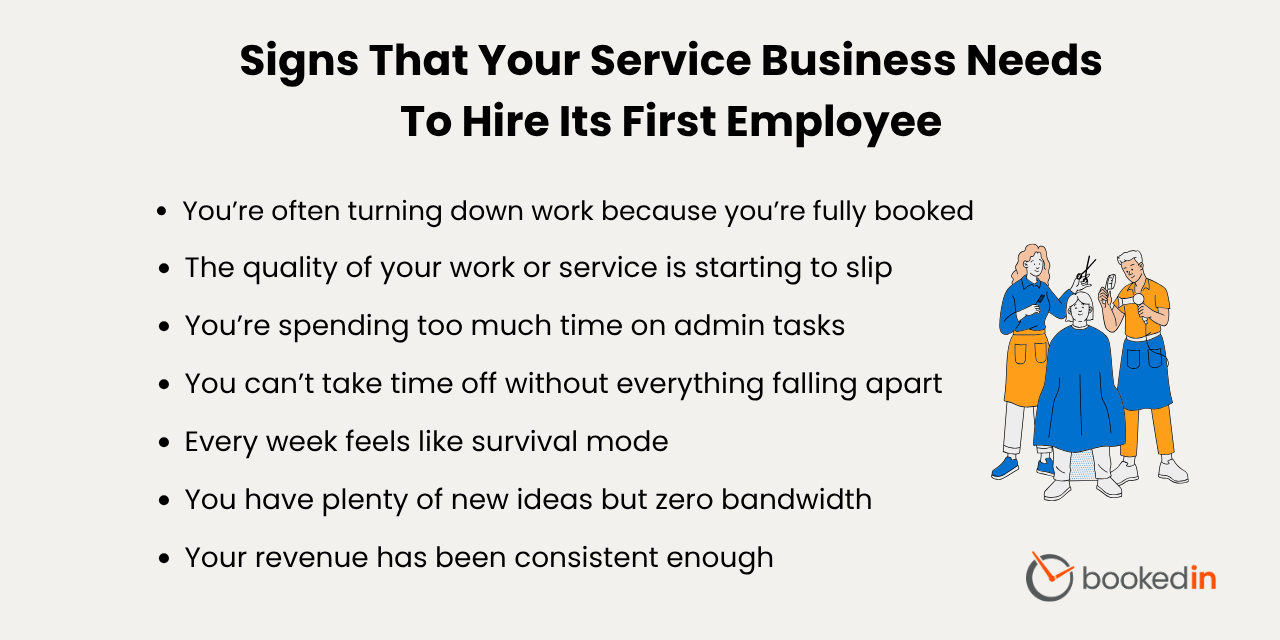
1. You’re often turning down work or being booked out way in advance
Being fully booked is typically a good problem to have, but only if you can actually keep up with demand.
When clients are consistently hearing that your earliest opening is three or more weeks away, most won’t wait around when there’s another shop nearby that can see them sooner.
Plus, you’re losing not just one appointment but also the chance to turn that person into a regular. At some point, working longer days on your own won’t solve that problem.
Also read: How To Say No to a Potential Client
2. The quality of your work or service is starting to slip
Here, the issue is that the people who are booking with you are starting to feel the effects of you being stretched too thin.
Maybe they’re waiting longer for replies to their messages, your sessions feel more rushed than they used to, or you’re forgetting some details at times.
The tricky part is that you might not notice it right away, because you’re so busy that even just “good enough” starts to feel normal.
You’ll usually know something’s off when some of your regulars stop coming in, or a review mentions that the quality of your service has changed. Those moments are easy to dismiss as one-offs, but sometimes they aren’t.
Also read: How To Keep Customers Happy: A Guide for Service Business Owners
3. You’re spending too much time on admin tasks
Take a rough count of how you spent your time last week. If a big chunk of it went to answering messages, updating your schedule, chasing payments, ordering supplies, and handling cancellations, chances are you’ve got a problem.
Admin work is necessary, but it doesn’t directly generate revenue the way client-facing work does. Some of it can be handled by the right tools, so it barely touches your plate.
But if you’ve already got those systems in place and you’re still spending a significant chunk of your week on tasks that don’t require your expertise? That’s a major sign your business needs another person.
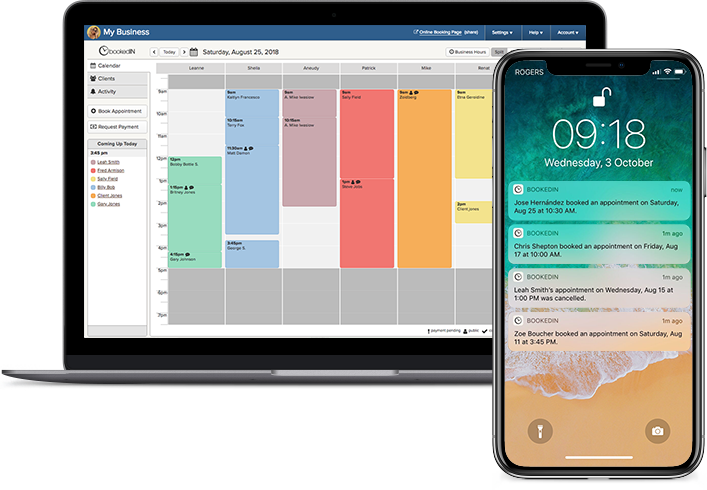
A client scheduling app that does the heavy lifting for you
With tools like automated reminders, calendar syncing, payment collection, and more.
4. You can’t take time off without everything falling apart
If the idea of taking even a few days off fills you with dread (not because you don’t want a break, but because there’s literally no one to keep things running), that might be a red flag.
A business that can’t survive a long weekend without its owner has no real backup plan, and that’s risky for more reasons than just burnout. What happens if you suddenly get sick or have a family emergency?
When there’s no one else who can keep things running, your options are limited. You either power through (which isn’t sustainable) or shut down temporarily (which costs you money and can frustrate loyal clients). Neither is a good long-term plan.
5. Every week feels like you’re in survival mode
There’s a big difference between a temporary crunch and a permanent state of overwhelm. However, when you’re living through either of these, it’s hard to tell the difference.
A busy holiday season, a sudden wave of client bookings after a viral post, or a one-time event that packs your calendar — those are temporary crunches. They’re tiring, but they end eventually, and you recover.
What’s not temporary is when every single week feels like a sprint for you. If you’ve been constantly overwhelmed for two or three months straight with no end in sight, your business likely needs another employee to help you keep up.
6. You have plenty of new ideas but zero bandwidth to act on them
You’ve probably had some ideas for how to grow your business. Maybe it’s adding a new service, launching another class, running a promo event, partnering with a local business, or even just posting on social media more consistently.
The problem, though, is that you aren’t able to work on any of your new ideas. You’re so busy with keeping the current version of your business afloat that you don’t have the time and energy to invest in the next version.
This is one of the sneakier signs because it doesn’t look like a problem on paper. If none of your growth ideas have moved forward in months (or longer), you most likely need someone to share the workload.
7. Your revenue has been consistent enough
All the signs above are about how things feel, but this one’s about whether the numbers actually back it up.
If your revenue has been stable and predictable even outside peak seasons, then that might be a good indicator that hiring an employee is feasible.
You don’t need to be drowning in profit, but you do need to see a pattern that suggests your business can sustain a second person without putting you in a tight spot.
Things To Do Before You Start Hiring for Your Small Business
A bit of groundwork before you start the process will save you time, money, and a fair amount of stress down the line.
Figure out exactly what you actually need help with
Before you can hire the right person, you need to know what you’re actually hiring them to do. That sounds obvious, but plenty of business owners skip this step and end up with someone who can’t solve the problem they were hired to fix.
Start by writing down the tasks that are eating your time or falling through the cracks. Then, ask yourself whether you need another person who can directly serve clients or someone who handles the operational side so you can focus on client work.
Also, think about whether you need someone full-time, part-time, or on a contract basis.
For many small businesses, starting someone part-time is the smarter move, since it lets you test the arrangement, manage costs, and scale up once you’re confident the hire is working out.
Check that you can realistically afford to hire someone
Hiring is a financial commitment, and it’s worth knowing exactly what you’re signing up for before you make an offer.
Start with your revenue over the past three to six months — not just your best month, but a realistic average. Remember that wages are a recurring cost, not a one-time expense.
From there, factor in everything beyond the hourly rate or salary: payroll taxes, workers’ compensation insurance, any tools or supplies they’ll need, onboarding time, and payroll processing fees. If you plan to offer benefits, add those in too.

See how your business is really doing
Track client bookings, payments, and other business data with Bookedin's Reports feature.
Get your systems in order first
If your calendar, client records, and payment collection are disorganized or largely manual, training and onboarding a new hire becomes significantly harder.
Getting those sorted before someone joins gives them a clear system to step into from day one.
Fortunately, a tool like Bookedin makes that easier. It comes with many various features that help ensure your operation is already running smoothly before anyone new comes on board.
Schedule a free demo to learn more
Write down how your business runs
Take the time to write down the basics: how you greet clients, how appointments are managed, what your cancellation policy is, how you handle complaints, and anything else that happens regularly.
It doesn’t need to be a long document. Even a simple one-page overview of your key processes and expectations gives a new hire something to refer to and reduces the back-and-forth during those first few weeks.
It also forces you to think through how you want things done, which makes training a lot more straightforward.
Understand the legal basics
Hiring an employee comes with legal and administrative responsibilities that vary depending on where your business is based. So, it’s best to do some research specific to your location before you commit.
That said, most places require a few of the same basics: registering as an employer, understanding your payroll tax obligations, and carrying some form of workers’ compensation or employer liability insurance.
You’ll also need to be clear on whether you’re hiring an employee or a contractor. That distinction matters legally almost everywhere — and getting it wrong can lead to penalties.
If you’re unsure where to start, get in touch with a local accountant or HR professional. It’s a small upfront investment that’s well worth it to make sure you’re set up correctly from the start.
Common Mistakes To Avoid When Hiring for the First Time
Recognizing the signs for when to hire employees for a small business is one thing; actually hiring well is another.
Below are the most common mistakes you should watch out for.
- Hiring out of desperation rather than readiness: Make sure you don’t skip the steps that actually matter, such as properly defining the role, vetting candidates, and making sure the timing makes financial sense.
- Bringing on a friend or family member without clear expectations: Hiring someone you personally know isn’t automatically a bad idea, but you should still treat the process exactly as you would with someone you’ve never met before.
- Skipping a trial or probationary period: It’s hard to know how someone will actually perform until they’re doing the job. So, use the first 30 to 90 days to assess whether the hire is working out before you’re fully committed. It also gives the new employee a chance to settle in and ask questions.
- Throwing the new hire in without proper onboarding or training: Before they start, write down the basics — like your processes, policies, and expectations. Otherwise, they might make decisions that don’t align with your standards.
Keep your business organized & booked solid
Everything you need to manage your schedule in one place.
- ✓ Take deposits
- ✓ Automatic reminders
- ✓ Calendar sync
- ✓ Mobile-friendly booking
FAQ About When To Hire Employees for Your Small Business
How much does it cost to hire your first employee?
The exact figure will vary depending on your location, industry, and the role itself. That said, most estimates put the true cost of an employee at 1.25 to 1.4 times their base wage once everything beyond the hourly rate or salary is factored in.
That includes payroll taxes, workers’ compensation insurance, equipment or supplies, and payroll processing fees.
So, if you’re hiring someone at $20 an hour, the real cost is closer to $25–$28.
Can I hire someone part-time to start?
Yes, and for many small businesses, this is the smarter move.
Hiring someone part-time at first lets you test whether they actually make things easier, whether they’re a good fit, and whether the business revenue can comfortably support the added cost.
You can always increase their hours as the business grows and the need becomes clearer.
What should I look for when hiring my first employee?
Skills matter, but so does fit. Look for someone whose work ethic and personality align with how your business runs. You can teach a lot of things, but attitude isn’t usually one of them.
Someone who’s technically capable but doesn’t communicate well, show up reliably, or work within your standards can create more problems for you.
Should I hire someone experienced or train someone new?
It depends on the role, what your business actually needs right now, and how much time you have to train.
An experienced hire can contribute faster but may cost more and come with habits that don’t match how you do things.
Someone newer is often easier to shape around your standards, but requires a bigger upfront investment of your time.
About the Author

With over a decade of experience across startups, online publications, and agencies, Marcy is all about delivering content that connects brands with the audiences they're trying to reach.