How To Stop Thinking About Work at Night (When You Own the Business)
Picture this: You’re lying in bed and trying to sleep, but your brain has decided it’s time to go through a seemingly endless list of things to worry about.
And sure, everyone has nights like this now and then. But for business owners, though, these tend to happen a lot more often, since you’re the one mainly responsible for everything (even when you have staff to help).
So in this article, we’ll go through why it’s so hard to stop thinking about work at night when you’re the owner, as well as what you can do about this.
Why It’s Harder To Switch Off When You Own the Business
There are three main reasons why business owners tend to find it harder to stop thinking about work at night:
- You’re the one who has to decide on things (that nobody probably trained you for). Whether to raise your prices, for instance. An employee flags something like that and waits for an answer, whereas you’d have to come up with it yourself.
- Nothing marks the end of your workday. You don’t have an actual clock-out time, and most owners just keep going until they’re too tired to carry on. There’s no clear point where your day is officially over, so oftentimes your brain assumes the work is still ongoing.
- Closing up for the day doesn’t stop people from reaching you. Think a client wanting to discuss something at 10 p.m. or a supplier finally replying to your email from last week. These often could technically wait, but it almost always seems like a better idea to respond tonight rather than tomorrow.
So if you’ve been assuming you’re just bad at switching off, that’s probably not it. The way most small businesses run makes it genuinely hard, but fortunately, that’s the part you can change.
Next, we’ll cover some of the ways you can close out your day intentionally, take a few things off your own plate, and avoid (or at least lessen) the late-night thinking.
8 Tips To Help You Stop Worrying About Your Business After Hours
Let’s get into how to stop thinking about work at night. Some of these only need to be set up once, while others are small daily habits that take about 10 minutes.
1. Commit to a clear finish time for your workday
Pick a time and write it down somewhere you’ll actually see constantly, like a sticky note on your desk. It should be specific, such as 7:30 p.m. on weekdays and 4 p.m. on Saturdays (nothing vague like “early evening-ish” or “after I’ve caught up”).
Make sure your end time isn’t the same as when your last client or customer leaves. For example, your closing time might be at 8 p.m., but after that, you probably still have to finish cleaning up or preparing some things for tomorrow.
So, make sure to factor those in when deciding on an end time that you. And yes, there’ll be days when you won’t be able to follow it (e.g., an appointment running longer than expected), but just try to stick to it as closely as you can.
2. Separate business notifications from personal ones
This is especially applicable if you don’t have separate phones for work and personal stuff. In this case, some business owners choose to leave all their notifications on because they think they might miss texts from friends and family.
But what you can do instead is set up a quiet mode that only applies to your business apps. Depending on what phone you use, that can either be a Focus mode, Do Not Disturb, or Bedtime mode.
Set it to turn on at your end time each night, then pick which business apps go silent (e.g., your booking app, whatever you use to message clients) and which people can still reach you.
If you’d rather not mute your business apps entirely, give them their own notification sound instead. That way, you can easily tell a client email from a friend’s text without picking up your phone to check.
3. Set up an automatic reply for client messages
Going quiet at night is a lot easier when you have an away message that tells clients when to expect a reply from you and (if applicable) what they can do in the meantime instead.
Most business messaging apps let you set up a reply that goes out automatically whenever someone messages you outside your shop hours. Here’s an example of an away message you can copy and adjust, particularly if you run a service business:
Thanks for reaching out! I’m done for the day and will get back to you tomorrow. You can also check my open slots and book directly at [link to your booking page].

Take client bookings around the clock
Clients can check your availability and book a slot on their own, even after you've closed for the day.
4. Decide ahead of time what counts as an emergency
Sometimes it’s hard to tell what’s urgent when you receive a work-related message at 10 p.m. So, it’s best to decide in advance which situations actually need your attention, so you can really think things through.
Write down at least two or three situations that apply to your work. For most owners, that’s things like a staff member calling out sick for tomorrow, a problem with an order that needs to go out first thing, or a security alert at your shop or office.
If you run a service business, a client cancelling an early-morning session could make the list too, so you’re not getting up early for nothing.
Keep the list somewhere easy to find, like your phone’s notes app. That way, when a message comes in after hours, you just check whether it’s on the list. If it isn’t, then it can wait until morning.
5. Finish or schedule the task that’s been on your mind all day
Most days, there’s one thing that keeps nagging at you. It might be an email you’ve been putting off for weeks, an invoice you haven’t sent, or a customer who’s been waiting on a reply from you since lunch.
If it’s something that’ll only take around five minutes, it’s best to get it done before you wrap up for the day, so it isn’t on your mind all evening.
And if it can’t be done that day, write down the exact next step and when you’ll do it. Having a set time to deal with it makes it much easier to leave it alone until then.
For example, if you still haven’t sent that invoice because you’re missing a few details, write on your to-do list something like “Email the client at 9 a.m. to confirm the final hours, then send the invoice.”
6. Automate the things you’d otherwise check on at night
Usually, what makes you pick up your phone at night are the small admin tasks you’re tracking in your head. Did that booking or order confirmation go out? Has the customer paid yet? Did anyone remind the client about tomorrow?
Most of the tools you already use can handle these for you. Online stores send order confirmations on their own, while accounting software can send payment reminders when an invoice is overdue.
Setting these up once means fewer things for you to keep track of, and less reason to open your laptop after dinner.
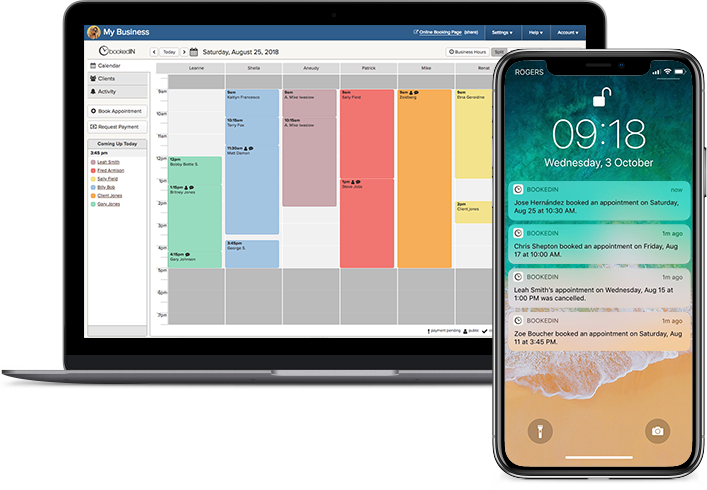
If you run a service business, a scheduling tool like Bookedin can take a lot of this off your plate.
The client scheduling app that does the heavy lifting for you
With tools like automated confirmations and reminders, payment collection, and more.
7. If you have staff, let them handle what they can without you
Most of the questions your staff message you about probably come down to two things. Either they couldn’t find what they need, or they’re not sure if they’re allowed to decide on something without your approval.
So give each person access to the tools they use every day, like your order system, inventory, and shared inbox.
Also, let them know beforehand which decisions they can make on their own, such as replacing a damaged item or issuing a refund under a certain amount.
If you run a service business, that might mean deciding whether to squeeze in a same-day booking, or where to offer a small discount when a client’s session runs late.
Once your team has access to what they need and knows what they’re allowed to decide, more things get settled before everyone clocks out, and your team doesn’t have to wait on you either.
8. Keep a notepad by your bed instead of your phone
When a work thought pops up at 1 a.m., the instinct is usually to grab your phone, either to check on something or to type quickly on your notes app so you don’t forget.
The problem is that once your phone is in your hand, it’s easy to end up doing plenty more things you didn’t intend to. You’ll likely spot an unread email or other notifications, and now you’re wide awake and back at work.
To keep that from happening, keep a notepad and pen on your nightstand so you can write the thought down without picking up your phone
Your notes don’t have to be that detailed, either. A short line like “Call the supplier about the late delivery” should be enough to remind you in the morning. The main thing here is to write it down on paper so you can get back to sleeping or winding down for the night.
Final Thoughts on How To Stop Thinking About Work at Night
Once work is wrapped up, it helps to give the last hour or so of your evening (or whatever your after-work hours are) a different feel from the rest of the day.
It doesn’t even have to be elaborate. Changing out of your work clothes, taking a shower, cooking dinner or going for a short walk can all signal that the workday is done.
If you like to read before bed, a physical book keeps you away from your phone. Exercise can help too, even something light like a walk after dinner or a short yoga session, as long as you leave some time before bed
That said, if you’re still lying awake thinking about work most nights for months (rather than during the occasional busy week), a better routine probably won’t be enough.
In that case, it’s worth looking at the bigger picture, like whether your prices cover your time, whether your hours are sustainable, or whether it’s time to hire staff.
In the long run, the goal is a business that can keep running without you checking in every evening. Each task you automate or hand off is one less thing on your mind at bedtime.
Keep your business organized & booked solid
Everything you need to manage your schedule in one place.
- ✓ Take deposits
- ✓ Automatic reminders
- ✓ Calendar sync
- ✓ Mobile-friendly booking
FAQ About How To Switch Off From Work as a Business Owner
About the Author

With over a decade of experience across startups, online publications, and agencies, Marcy is all about delivering content that connects brands with the audiences they're trying to reach.